Hannah Arendt’s life and ideas offer a profound warning about the fragility of truth in the face of tyranny.
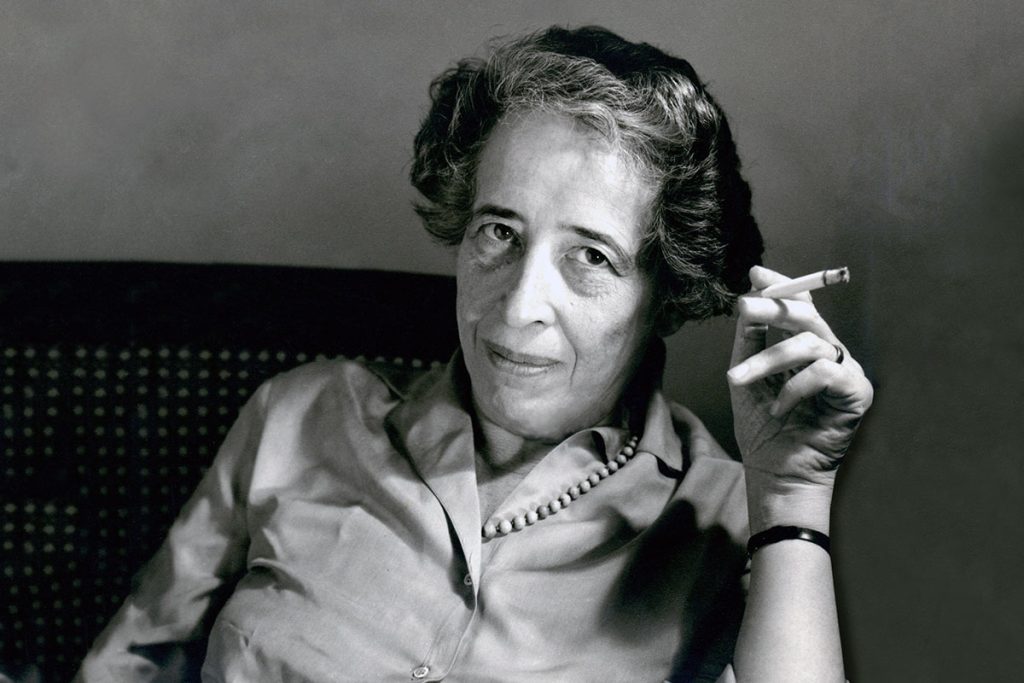
21 December 2025 – Born in 1906 in Hanover, Germany, to a secular Jewish family, she lost her father at the age of seven and was raised by her mother in an environment of intellectual freedom. She pursued philosophy, studying under Martin Heidegger and Karl Jaspers, and emerged as a brilliant thinker.
Yet her Jewish identity placed her in peril when the Nazis rose to power in 1933. In that year, Arendt was arrested by the Gestapo in Berlin for conducting illegal research into antisemitism, gathering evidence for a Zionist organisation. She spent several days in a Gestapo cell before being released, likely due to a sympathetic officer.
She fled Germany immediately, first to Prague and then to Paris. When France fell to the Nazis in 1940, she was interned as an enemy alien in the camp at Gurs. She escaped and, with the help of networks including Varian Fry, made her way across the Pyrenees to Spain and Portugal. In 1941 she arrived in New York, a refugee with little more than her life and her urgent questions about how a cultured nation could descend into barbarism.
These experiences shaped Arendt’s lifelong project. She spent decades examining how ordinary people participate in evil, how truth is eroded, and how resistance remains possible. Her seminal work, The Origins of Totalitarianism (1951), analyzed Nazi Germany and Stalinist Russia as systems that destroyed not only lives but reality itself. She argued that the ideal subject of totalitarian rule was not the fervent believer but those for whom the distinction between fact and fiction, true and false, no longer exists. Totalitarianism thrives on relentless lying, not to persuade but to overwhelm, leaving people cynical and paralyzed, unable to judge or act.
Arendt’s most controversial insight came from covering the 1961 trial of Adolf Eichmann in Jerusalem for The New Yorker. Eichmann, a key organiser of the Holocaust, appeared not as a monster but as a banal bureaucrat, driven by careerism and obedience rather than hatred. She described this as “the banality of evil”: most evil is done by people who never decide to be good or evil, who stop thinking and surrender judgement to authority.
In a 1973 interview with French journalist Roger Errera, amid the Watergate scandal, Arendt observed that constant lying erodes belief itself. If everyone lies, people stop believing anything, losing their capacity to think and act. A population thus deprived can be manipulated at will.
Yet Arendt refused despair. In Men in Dark Times (1968), she celebrated individuals who, in oppressive eras, offered illumination through courage and integrity. She emphasised “natality”, the human capacity for new beginnings inherent in every birth. No system can fully extinguish the potential for spontaneous action and resistance.
Arendt died on 4 December 1975 in New York, aged 69, from a heart attack while working at her desk. Her unfinished manuscript on judging was left mid-sentence, a fitting end for a thinker who lived by questioning.
Her warnings resonate today, in an era of disinformation and authoritarian tendencies. The real danger is not the dictator alone but the erosion of truth, when ordinary people grow exhausted or cynical and cease to distinguish fact from fiction.
Arendt’s antidote is simple yet demanding: think for yourself, preserve judgement, and kindle small lights of truth. Every act of resistance begins with refusing to surrender thought.