Text-to-image prompts can be extremely complex
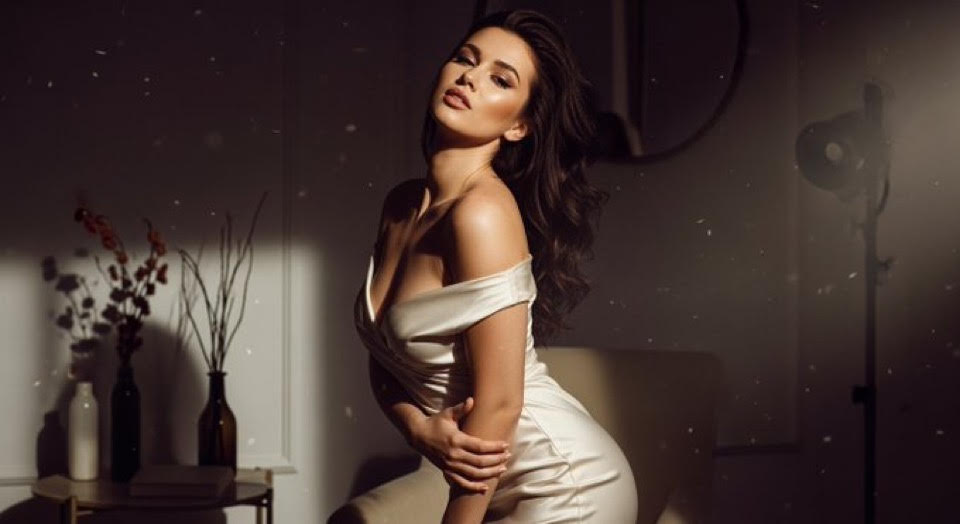
6 November 2025 – For the above image, here is the prompt (and see my notes below) :
{
“narrativeIntent”: {
“message”: “Effortless elegance meets confident sensuality”,
“emotion”: “Poise, allure, sophistication”,
“concept”: “A high-fashion editorial portrait of a confident woman radiating timeless beauty and modern grace”
},
“subject”: {
“identity”: “Elegant woman in her late 20s”,
“appearance”: “Slender silhouette, luminous skin, long flowing hair styled naturally”,
“pose”: “Relaxed yet confident, slightly leaning, one hand on hip, subtle head tilt”,
“expression”: “Calm, magnetic gaze, soft smile hinting at mystery”
},
“wardrobe”: {
“outfit”: “Light designer dress with flowing fabric and open shoulders”,
“style”: “High-end minimalist elegance”,
“details”: “Soft silk texture, natural drape, gentle movement in fabric”
},
“scene”: {
“environment”: “Modern studio with soft neutral backdrop”,
“elements”: “Diffused light, elegant shadows, minimal decor for focus on subject”,
“tone”: “Warm, intimate yet polished”
},
“camera”: {
“angle”: “Medium close-up or half-body portrait”,
“lens”: “85mm for soft background compression”,
“focus”: “Sharp on eyes, smooth depth of field on dress and background”
},
“lighting”: {
“type”: “Softbox and natural fill light”,
“direction”: “Side lighting for contour and depth”,
“effects”: “Gentle highlights on skin and fabric sheen”
},
“fx”: {
“atmosphere”: [
“Soft haze for cinematic glow”,
“Delicate particles catching the light subtly”
]
}
}
These are iterative prompts which involve providing a series of instructions or “prompts” to an AI model, with each one refining the output based on the previous results.
A reliable way to structure your prompt is to divide it into sections, acknowledging that the AI’s attention will taper off as it proceeds.
So you need to “build” your image.