How nationalists, religious fundamentalists and tech titans turned their backs on a shared future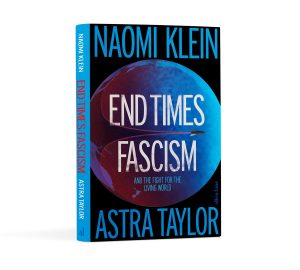
5 September 2026 – Two of my favorite journalists and authors, Naomi Klein and Astra Taylor, have a new book out, End Times Fascism: And the Fight for the Living World. I received a publisher review copy a few weeks ago (official issue date will be September 15th), and I found it quite a read. And this weekend they did a joint essay in the Financial Times (inserted below) which will give you a nice overview.
According to them, today’s rising authoritarianism is a sequel rather than a mere rerun. They argue that contemporary far-right politics differs fundamentally from 1930s fascism in 3 key areas:
1. An apocalyptic alliance. Unlike historical fascist regimes that promised a future pastoral golden age or a restored national utopia after conflict, today’s movement unites ethno-nationalists, religious fundamentalists, and Silicon Valley tech billionaires who anticipate and welcome ecological collapse, resource scarcity, and systemic shock.
2. The Bunker Mentality. Modern “end times fascism” operates with an awareness of planetary-scale crises like climate breakdown, nuclear peril, and unregulated artificial intelligence. Rather than trying to avert catastrophe, the elite in-group plans to bunker themselves away – whether in gated fortress nation-states, private islands, or off-world escapes -leaving the rest of humanity to face the fallout.
3. Nihilism over vision: Instead of offering a credible blueprint for a shared future, contemporary extremists offer a nihilistic loop of historical remixes and the sadistic pleasure of dominance over marginalized outsiders.
They go into more detail in the Financial Times piece which now follows:
____________________
Rerun or sequel? Naomi Klein and Astra Taylor on end times fascism
Financial Times
5 September 2026
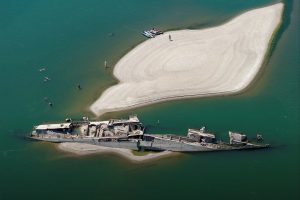
Above: A sunken German warship from the second world war is revealed by the low levels of the Danube in Serbia during this summer’s extreme heat
As relentless heat and drought lowered its water levels this summer, the Danube began to give up its secrets. Like monsters rising through the muck of time, sunken wreckage from the second world war has slowly materialised.
In Serbia, the drying river revealed at least 20 Nazi ships, some still laden with unexploded ordnance. In Hungary, it exposed a Nazi military motorcycle, caked in hot mud, not far from the rusted-out medals and name tags of two German soldiers. In Slovakia, a passer-by noticed a massive 1,500lb bomb poking out from the disappearing river, planted by the Royal Air Force. Slovak authorities needed to carefully transport the weapon, which had been submerged for more than 80 years, and detonate it deep underground.
For many observers, these ghostly and menacing visitations from Europe’s past have felt less like a historical curiosity than an overly literal metaphor — nature’s way of confirming William Faulkner’s adage that “The past is never dead. It’s not even past.”
The feeling that history is repeating itself is backed up by plenty of data points. All along the Danube, the past decade has brought a surge in nostalgia for a time when “European civilisation” reigned supreme, with each far-right wave flirting a little more brazenly with race-based policies and slogans that were supposed to have been buried with the dissolution of the Third Reich.
The extent of the resurgence came into focus in early 2025 at the Munich Security Conference. There, US vice-president JD Vance, freshly inaugurated, scolded European leaders for maintaining a political firewall against previously untouchable far-right parties. He also went out of his way to have a meeting with Germany’s Alternative für Deutschland, or AfD, which has circulated proposals for the “remigration” of huge numbers of people and whose former co-leader once dismissed the Nazi era as a “speck of bird poop” on the country’s history. The party is currently poised for an electoral breakthrough in at least one state.
Further east along the Danube, Austria’s Freedom Party (FPÖ), founded in 1956 by a former Nazi functionary, is enjoying greater popularity than at any point in its history, with senior FPÖ member Walter Rosenkranz now holding the nation’s second-highest office. Last year, Rosenkranz’s chief of staff was forced to resign after reports that an official investigation into the far-right Saxon Separatists had discovered a stash of ammunition and Nazi paraphernalia in a property linked to him, though he denied living there.
The group at the centre of the controversy just happens to have the initials “SS” — rather like Elon Musk, a vocal supporter of the AfD and others on Europe’s far right, just happens to have expressed his gratitude to Trump voters in January 2025 in a manner that was interpreted by many as a Nazi salute. (Musk dismissed the backlash, posting on his platform X: “Frankly, they need better dirty tricks. The ‘everyone is Hitler’ attack is sooo tired.”)
Like the sunken warships revealing themselves as the Danube recedes, fascism does seem to be making a comeback — in Europe, the US and well beyond. Yet having just completed a book on the distinctive qualities of contemporary fascism, we find ourselves uneasy with the linear historical comparisons. On the contrary, if we want to understand the far right today, we would do well to look beyond the rusted relics and focus on the alarmingly desiccated state of the riverbed.
Fascism always emerges during times of acute crisis. That was certainly true in the period when Benito Mussolini and Adolf Hitler pounded their fists to power. The first world war had slaughtered millions, crushed economies and crowded cities with impoverished orphans, widows and maimed veterans.
Yet the fact that we are now seeing mighty and vital river systems under such pressure (while glacial floods thousands of miles away wash away entire villages) is a reminder that today’s crises are very different from the ones that primed populations to search for strongmen and scapegoats a century ago. They are more planetary in scale and, as a result, more existential and apocalyptic in scope.
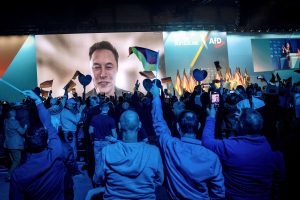
Above: Elon Musk speaks via video link to an AfD rally in Halle, Germany, in January last year
Hitler and Mussolini were both willing to unleash monstrous violence without limit. But both died before the famous Trinity test: they did not know a world in which humans possessed the power of nuclear weapons. Nor did they understand that tailpipes and smokestacks could alter the chemistry of our planet. Nor could these strongmen have imagined that a single private citizen could hold more wealth and technological power than the vast majority of nations.
Today’s fascists do not know a world without these planetary-scale weapons and perils, and they have evolved their violent ideology in tandem with them. These simple facts mean that we are not facing a rerun of the authoritarianism of the past. This is, instead, a sequel, taking us all to places we have never been before. We call this chilling new development “end times fascism”.
Writing in the 1950s, after fleeing the Nazis, German-Jewish philosopher Günther Anders reflected on the seismic shift ushered in by the atomic age: “Because we are the first humans in charge of the apocalypse, we are also the first to live under its threat.” For the first time, he observed, the prospect of human extinction — of omnicide — was on the table. “All these other supremacies had only ever posed a partial threat; they only ever annihilated individual entities: ‘only’ humans, ‘only’ cities, ‘only’ kingdoms, ‘only’ cultures — but we continued to be spared (if this ‘we’ is understood to mean humanity).”
Today there are no such guarantees, particularly as artificial intelligence compounds a range of existential risks, including by consuming massive amounts of climate-heating energy, ushering in democracy-endangering levels of concentrated wealth and raising the threat of rogue tech.
Thirty years ago, the Italian philosopher and theorist Umberto Eco — who lived through Mussolini’s reign in Italy — observed that fascism always has “an Armageddon complex”, explaining that “since enemies have to be defeated, there must be a final battle, after which the movement will have control of the world”.
But as Anders understood, while the violence that European fascists inflicted on their internal out-groups and external enemies was indeed apocalyptic, they were not typically imagining the actual end of the world so much as the destruction of particular parts of it. Most foresaw a future where the wars came to an end and a purified, wealthy, stable national body emerged.
Importantly, that promise of a stable future was not just for the rich, but for the working-class base as well. The Nazis promised their Aryan followers farmland stolen from Slavs, and houses stolen from Jews, connected by new and robust infrastructure built through massive public works. It was a hideous and blood-soaked dream, but for the in-group the benefits were tangible.
It is here that Donald Trump and the other far-right leaders in his orbit depart sharply from their predecessors. Yes, during election campaigns there are various visions of a golden age dangled in front of the base — a return to 1950s industrial jobs, with tradwives and obedient children waiting at home, or the hope that crypto will unleash economic freedom. But the robots seem to want all the jobs and, after lavishly enriching the Trump family, crypto isn’t delivering either.
Meanwhile, the politicians and corporate elites driving end times fascism appear to have no plans for a stable future accessible to the non-rich. Instead, they are betting on permanent “bad times”, as Palantir’s chief executive Alex Karp once put it, imagining a world where relatively small groups survive, protecting themselves and their wealth even amid roiling chaos, conflict and serial disasters.
In this way, end times fascism offers little more than the chance to believe in one of its visions of bunkered survivalism. Maybe that is the dream of merging with “superintelligent” machines and avoiding being part of what Silicon Valley coders now casually refer to as the “permanent underclass”. Maybe it’s the idea of keeping “your kind” safe inside a racially purified nation state, permanently fortressed and fortified against the needy in a burning world. Maybe (if you are wealthy enough) it’s a seat on one of Musk’s rocket ships and a Neuralink chip as he claims to safeguard our species’ fate by making us “multiplanetary”. In each case, the fate of this world — and the possibility of a shared, sustainable future — is being written off.
To be clear, end times fascism is not a monolith; fascism is always much messier than that. Instead, it’s a fractious and dangerous alliance of three main factions: the religious fundamentalists, the tech accelerationists and the militant ethno-nationalists.
Not that long ago, a truly end times worldview was limited to fringe corners of the religious right. Its theocrats and true believers scoured current events for signs that Judgment Day would soon arrive, certain they would be raptured to heaven as the remains of human civilisation descended into chaos and Armageddon. Now, these extremists have managed to become a major force within the governments of the US and Israel, where they pursue a policy of strategic military conflict with the aim of fulfilling what they believe to be biblical prophecy. Just this week Vance, in an interview with an evangelical podcaster, mused that his actions might bring about the “end times” while admitting that he wouldn’t be “shocked if the Antichrist was walking among us” — an echo of his patron and mentor Peter Thiel.
Indeed, a messianic, millenarian attitude has come to suffuse Silicon Valley, where tech titans race to build digital deities that they claim will either bring about the promised land or destroy everything. (AI, Sam Altman once said, “will probably, most likely, lead to the end of the world, but in the meantime, there’ll be great companies”.) A similar nihilism undergirds the fixation on border “invasions” and “great replacement” ideology and the apocalyptic claim that immigration is a form of cultural “suicide” and “erasure” (which is the only part of the alliance with any real mass appeal).
Notably missing from all of these bunkered visions is any plan to actually address the drivers of our most urgent collective crises; if anything, there seems to be a determination to accelerate calamity on every front.
Which brings us back to Europe’s summer of record-breaking heat and drought. During the same brutal summer that exposed those Nazi relics, there were 16,000 excess deaths in a single week in Europe and huge swaths of the continent burned, displacing hundreds of thousands of residents. As Spaniards fled for safety, Santiago Abascal, leader of Spain’s hard-right Vox party, pointed an accusatory finger at the “climate fanaticism” and government corruption that he claimed enabled the fires.

Above: Spain’s hard-right Vox leader Santiago Abascal speaking to the media in Ceuta last month
Abascal also rushed to change the subject, pivoting away from the climate disasters that Europeans were experiencing to the supposed emergency of human migration in north Africa. He falsely characterised the tens of thousands of migrants who crossed into Ceuta at the end of July as a raping and marauding “invading army” (never mind that Ceuta is part of Spain only because of centuries of real invasions, or that nearly all the migrants were almost immediately returned to Morocco, though many drowned during the tragedy). Abascal was backed by a global rightwing chorus that included everyone from Trump to Argentine President Javier Milei, all fuelling an atmosphere of panic and hysteria over the Ceuta spectacle, which continues to spark anti-immigrant protests a month later.
It’s a familiar playbook: Trump has repeatedly placed claims of imminent “invasion” at the centre of his election campaigns. José Antonio Kast, the Chilean president elected in March, campaigned pledging to build trenches and walls along the borders with Bolivia and Peru. Marine Le Pen, currently enjoying what may prove an unstoppable comeback in France, in 2019 blasted immigrants as “nomadic” individuals who “do not care about the environment; they have no homeland”.
All of this is why we believe that end times fascism — with its fortressed borders, decimated foreign aid and fixation on grabbing the resources beneath Greenland’s melting ice — should be seen as a twisted and sadistic form of climate-change adaptation. Now that the reality of planetary heating has become undeniable, all that is left to deny is the humanity of our fellow humans. How else can one rationalise allowing so many to starve on barren lands in Somalia, or to drown in search of survival off the coast of north Africa, or to die in ICE detention camps in the US?
Research shows that far-right parties hold particular appeal for young men. Such supporters are part of a generation who fear they will never own a home — but there are compensatory pleasures to be had in owning the libs with a culture of constant online trolling. Convinced that their future has been stolen, they share rose-tinted memes romanticising the authoritarianism of the past.
In a similar way that conspiracy theorists get the facts wrong but the feelings right, end times fascists tap into deep feelings of insecurity and unease, including the uncanniness of a world in which the seasons are scrambled and where it’s becoming harder to distinguish real from fake. They tell us that the reason we no longer recognise our hometowns is the number of kebab shops and minarets and the immigrants coming to “replace” us — and not, for example, the unrecognisable weather patterns, or the tech executives who are racing to replace all of us with robots and summon their digital deities.
Far-right leaders, meanwhile, see an upside to this uncertainty and disorientation. They clearly grasp the ways that reactionary politics flourish in periods of instability and strife, and how precarity can prompt people to turn on one another as they cling ever more desperately to whatever scraps of protection and privilege they possess.
A century ago, similar dynamics played out to disastrous effect across Europe. But the US, facing equally severe crises, took a different path. As the country struggled to recover from the Great Depression and racist demagogues found receptive audiences, labour organisers and political leaders forged an alternative.
Franklin Delano Roosevelt made the case that Congress should increase public spending as part of the domestic fight against fascism. “Democracy,” he said in a radio address, “has disappeared in several other great nations — not because the people of those nations disliked democracy, but because they had grown tired of unemployment and insecurity, of seeing their children hungry while they sat helpless in the face of government confusion and government weakness through lack of leadership in government. Finally, in desperation, they chose to sacrifice liberty in the hope of getting something to eat.” The New Deal helped deprive political extremists of oxygen by fostering stability and meeting people’s real needs.
As we have seen, history does not repeat on a loop. Yet FDR’s central lesson still holds: there is no way to fight off the fascist threat without combating the true material crises that make it harder for people to resist strongmen and scapegoats. Today, those causes look different to how they did in the 1930s. Yes, we still need to generously fund essential services that provide for the basics of life and invest in well-paying socially productive jobs. But we also need to do all of this in ways that address the global existential risks that define our time: climate change, nuclear weapons, generative AI and unchecked wealth and power.
People are already pushing for these kinds of solutions. We can see it in the rapidly expanding movement demanding democratic governance over AI, and winning freezes on data centre construction until it is in place; in the global campaigns to tax billionaires, and even impose a cap on wealth; and in the historic number of US politicians voting to stop arming Israel, and opposing the widening conflagration in Iran. It’s there, too, in the renewed focus on climate action coming from insurgent Democratic Party candidates who support a Green New Deal, alongside Medicare for All.
There is a long way to go before we have responses on the scale of the crises we face, but a growing number of ordinary people and political leaders understand something simple and urgent: that the best way to help their neighbours resist the allure of end times fascism is to make their lives better in the here and now.