Anthropic says that hackers used the AI in attacks against targets on the Ukrainian government, military and diplomatic sectors
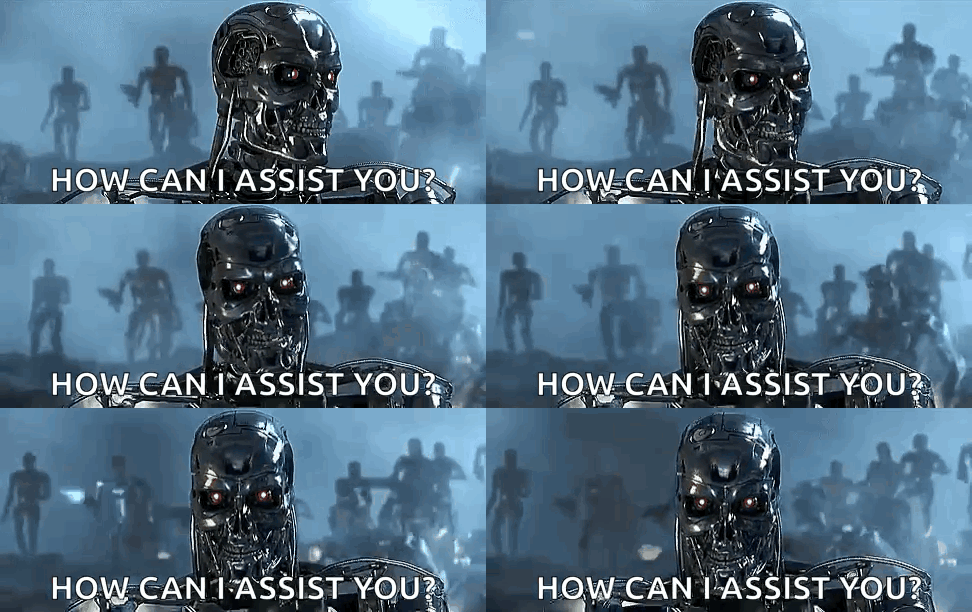
12 September 2026 (Athens, Greece) – About 3 years ago my military/geopolitical/intelligence clique organized a conference called War 4.0 which would be the first of a series.
At first we met once a year, for 1/2 day. Now we meet twice a year for 2 full days. We alternate between Athen and Berlin. One of the debate points was whether the primary use case of AI would be in the conduct of war – a highly debated topic among technologists, ethicists, and geopolitical analysts. While defense applications are rapidly accelerating on modern battlefields, others argue that AI’s vast integration into civilian life – such as healthcare, productivity, and finance – proves its primary impact lies elsewhere.
But the clique universally believed that the case for warfare was the primary driver. Historically, the advancement of groundbreaking technology has often been heavily funded and driven by the desire to gain military supremacy. In the context of modern conflicts, AI has quickly transitioned from a theoretical tool into an active battlefield driver.
But whatever side you fell on, one thing was true: we were in War 4.0 – AI, and especially drone warfare, had made a paradigm shift toward algorithmic, AI-driven, and autonomous drone warfare. As the line between experimental prototypes and frontline combat continues to blur, it was imperative to stay current and discuss the rapid integration of artificial intelligence into multi-domain operations.
And blame the Russians. Russia isn’t preparing for World War III. It believes World War IV is already underway. While the West debates whether a global conflict is looming, the Kremlin sees things differently. To Moscow, the Cold War was World War III – a battle of ideology and influence that ended with the collapse of the Soviet Union. Now, Russia sees itself fighting World War IV, not with tanks and missiles, but through deception, disruption, and destabilization – and now, super advanced drone warfare.
Modern warfare is no longer about mass armies clashing on battlefields. Ukraine showed it might start that way, but Russia knew it could not compete with the West’s military and technological superiority unless it developed its own superiority. It had waged war in the shadows, exploiting the vulnerabilities of open societies. Propaganda confuses, disinformation divides, and social unrest weakens adversaries from within. But it still needed kinetic power.
It’s why Russia’s alliances have extend beyond rogue states like Iran and North Korea. It also works with non-state actors – Hamas, Hezbollah, narco cartels, human traffickers, and cybercriminals. These groups don’t wear uniforms or march in formation, but they are instrumental in spreading chaos, eroding Western stability, and carrying out operations that Russia can deny involvement in.
But it was Iran and North Korea that helped it build the kinetic power – plus the technology it stole from the West.
The West is totally unprepared. It’s Bamby versus the crocodile.
The big discussion this morning was the news that broke last night, which I assume most of you saw.
A small team of freelance developers based in Russia used AI chatbot Claude to develop software for an autonomous swarm of first-person-view “kamikaze” attack drones, including terminal guidance, target selection and coordination between multiple aircraft, according to Anthropic, the company that developed Claude.
Note to readers: And it is (sort of) in follow-up to a story I broke a few weeks ago – the first autonomous killer drone found in Ukraine that was guided entirely by AI. Ukrainian officials said was a Russian drone with an Nvidia chip and presages a dystopian future of weaponry untethered to humans.
In a 154-page report describing how bad actors used its Claude AI system for state-sponsored surveillance and propaganda operations, Anthropic said the drone swarm was programmed to pick its own targets and crash into them to detonate, without a human making the final call. In their programming, the freelance team repeatedly picked a location in Ukraine’s Donetsk region as their target and used VPNs to circumvent Anthropic’s geographic blocks. Small drones have become a central weapon in the war in Ukraine.
Anthropic also found that cybercriminals and state-backed hackers are increasingly using AI to orchestrate and execute large portions of cyber-attacks, including in attacks targeting officials in Ukraine.
It’s a detailed report. Some highlights:
– One hacking group initiated phishing operations, hotel wifi hijacking and WhatsApp-takeover operations against targets in the Ukrainian government, military and diplomatic sectors, using AI at nearly every stage
– The group’s tradecraft is completely consistent with Russia-based threat actor Midnight Blizzard, which the US government has previously linked to Russia’s SVR foreign intelligence service
– The group allegedly used AI to build a system that automatically detected when its malware was flagged by security defenses, and then rewrote the code until it evaded detection
The Anthropic report comes as petrol stations in Kyiv have been hit by jet-powered, AI drones in a wave of targeted Russian attacks as the bombardment of Ukraine’s capital enters a new phase of intensity. The Ukraine military intelligence service was able to access a list of 18 petrol stations in Kyiv expected to be hit by Russian drones. Three on that list have been struck so far. 8 civilians have been killed.
Note to readers: Russia is not simply trying to defeat Ukraine. It is trying to make the country impossible to live in. The aim is not just to target civilians and critical infrastructure across Ukraine, but to make everyday life increasingly difficult. In recent weeks, Russian strikes have hit food warehouses and distribution centres supplying retailers across Ukrainian cities with gaps reportedly already appearing on supermarket shelves. These are not abstract economic targets. They are the networks that allow millions of people to live, work, travel, eat and raise families normally.
The report is an eye-opener. Claude helped build drone software designed to identify a person, choose the target, and detonate without waiting for any human input. Anthropic says the Russian accessed Claude Code while building parts of an autonomous FPV drone swarm.
The work included swarm coordination, computer vision, terminal guidance, and an onboard model governing attack behavior. They tested the system in simulation and on real development hardware, repeatedly using a location in Ukraine’s Donetsk region as a demonstration strike point.
AI is reducing the expertise required to build increasingly autonomous weapons. A small team can now access capabilities that once required much larger engineering resources. The monster is out of the cage. As if it was ever in a cage to begin with.
And the implications go beyond drones. As models get better at coding, targeting, and coordinating machines, the real question becomes how much irreversible authority humans are willing to hand over to software. The dangerous threshold has arrived before AI becomes smarter than us. It’s capable enough to choose who gets targeted without asking again.

I wrote this during the lunch break and I’ll let me team edit if they have time. A few concluding thoughts.
Over the last two years I have had the opportunity to go into today’s war rooms. I have seen AI‑enabled weapon systems – from targeting software to autonomous drones – designed, tested, and folded into everyday military routines, and how these routines reset expectations about what is “acceptable” in war.
Yes, “acceptable”. An amusing concept. But moot. For technologies in warfare, there is a long history of use before diplomats even begin to debate them as something that needs to be governed. Then it’s just too late. As it will be this time.