A front that hardly moves, soldiers taking refuge in the trenches and relentless artillery fire. What is unfolding there is indeed a war of position. And from experience, we know the kinds of injuries it causes: ravaged faces and amputations.
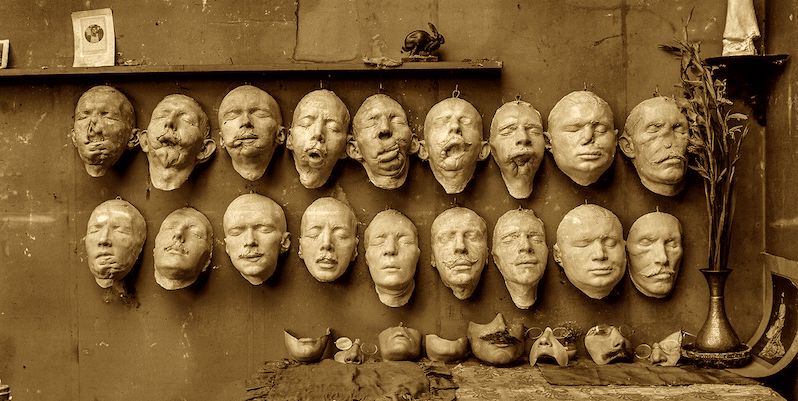
ABOVE: the image shows the studio of American sculptor Anna Coleman Ladd in Paris in 1918, during World War I.
•Top Row: Plaster casts taken directly from the mutilated faces of World War I soldiers (gueules casséesor “broken faces”)
•Bottom Row: Sculpted clay or plaster models where Ladd reconstructed the missing features
•Table/Bottom: The final, painted copper portrait-masks created to match the soldiers’ original appearances and skin tones.
Ladd founded the American Red Cross Studio for Portrait-Masks to craft these custom prosthetics, helping severely disfigured veterans regain their confidence and social integration.
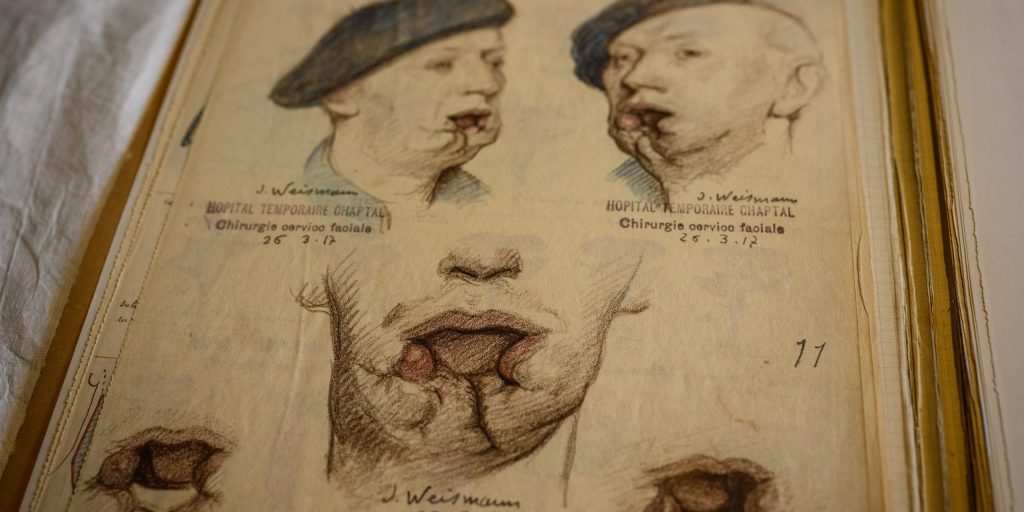
BELOW: image shows a historical medical illustration page documenting World War I facial reconstructive surgery, specifically featuring a patient named J. Weismann , at the Hôpital Temporaire Chaptal (Paris, France), which treated severely wounded soldiers (“gueules cassées”) during World War I.
11 November 2026 (Athens, Greece) – After 6 glorious weeks traveling across the northern island chain of the Dodecanese, a few days to settle back into the groove.
I thought I’d start with Armistice Day – the international day of remembrance observed annually on November 11th to mark the symbolic end of World War I. It commemorates the signing of the armistice agreement between the Allies and Germany, which silenced the guns on the Western Front at 11:00 AM on November 11, 1918 – famously referred to as the “eleventh hour of the eleventh day of the eleventh month”.
While the agreement effectively halted combat operations, it was a ceasefire rather than a formal surrender. The legal end of the war did not occur until the Treaty of Versailles was signed seven months later on June 28, 1919.
Everyone, everywhere, lives by a story. This story is handed to us by the culture we grow up in, the family that raises us, and the worldview we construct for ourselves as we grow. The story will change over time, and adapt to circumstances. When you’re young, you tend to imagine that you have bravely pioneered your own story. After all, the whole world revolves around you.
As you age, though, you begin to see that much of what you believe is in fact a product of the time and place you were young in.
It was a study of the First World War that turned it around for me. It was monumental in scope, larger and more devastating than anything in anyone’s experience. The factors leading up to it were a confusing tangle of alliances, feuds, and rivalries, and the ordinary person might be hard-pressed to say just what they were fighting for. So many had died, and for what?
It forced me to see the complexity of the world. And reject the faux social environment that rewards simplicity and shortness, and punishes complexity and depth and nuance. I simply detest it. To understand the world you need to step outside your usual lanes, and cross disciplines, and cultural boundaries.
As I have noted many, many, many times, to be an informed citizen is a daunting task. We move through myriad, overlapping spheres, ones that are forever entangled. Moving at an exponential pace – living through social and technological change on the scale of the Agricultural or Industrial Revolution. But occurring in only a fraction of the time.
And the resemblance of the Ukraine War to WWI is tragic – the surreal parallel between 1914-1918 and the deadly clashes currently taking place on the European continent. A front that hardly moves, soldiers taking refuge in the trenches and relentless artillery fire: What is unfolding over there is indeed a war of position. And from experience, we know the kinds of injuries it causes: ravaged faces and amputations.
The disfigured faces and amputated bodies of soldiers wounded in Ukraine are a stark reminder of the countless men mutilated in World War I. To treat the unprecedented injuries inflicted on the soldiers by shells, doctors improvised using rudimentary tools and the skilled hands of a handful of pioneering physicians.
That is why I opened the top of this post with illustrations/graphics of mutilation.
Because it is not the French soldiers of yesterday but the Ukrainian soldiers of today who will be at the heart of the Armistice Day commemorations of World War I today at the Museum of the Great War in Péronne, France, near the Somme battlefields. The museum has chosen to screen in its auditorium Les Visages de la guerre (“The Faces of War”), a documentary directed in 2025 by Didier Cros. The moving film features several heroes of the resistance to the Russian aggressor who were treated at the Vynnyky medical center near Lviv, western Ukraine. I will see the film later this year. But based on clips I saw in a review by Le Monde:
• There is Petro, wounded in a trench on the front line, Artur, injured during fighting around the city of Zaporizhzhia, and Andryi, a big, strong man who was saved by a miracle.
• Petro, Artur and Andryi were disfigured. Their mouths twisted, cheeks torn away, eyes half-closed – three faces straight out of a Picasso painting.
• From the past, images resurfaced of France’s own gueules cassées (“broken faces,” the soldiers with severe facial injuries from World War I), men like Albert, Marcel, Bienaimé, Mamadou and Joseph, who were mutilated more than a century ago in Verdun and on the battlefields of the Marne and the Somme.
A medic notes in the film:
“Many amputations, in fact, are tied to the inability to evacuate the wounded quickly. That was the case during World War I, and remains the case in Ukraine today. No medical evacuation helicopter ventures into a sky buzzing with Russian drones seeking the slightest target. ‘When you are seen, you are dead’, the fighters say. They also know that a tourniquet left on too long can cause tissue to die and lead to the loss of the bloodied limb”.
The violent traumas suffered by tens of thousands of wounded soldiers – Kyiv and Moscow keep the exact numbers of their military losses secret – are once again challenging military medicine.
For his film, Cros followed a team of French surgeons specializing in facial reconstruction who volunteered to operate in Vynnyky. These experts in the field, who work at the Pitié-Salpêtrière Hospital in Paris and the Amiens-Picardie University Hospital Center, have shared their expertise with Ukrainian practitioners seeking high-quality training. He says in the film:
“I was truly impressed by the remarkable technical skills and the great humanity of our caregivers. Watching them work, I thought they were worthy heirs to the pioneers in white coats from 1914-1918, who managed to develop incredible expertise even though they were completely unprepared for such a healthcare maelstrom”.
The director was right: World War I brought about significant medical advances, the most notable of which was the rise of reconstructive maxillofacial surgery.
When the global conflict broke out in the summer of 1914, the highly respected military surgeon Edmond Delorme (1847-1929), former director of the Ecole du Val-de-Grâce in Paris, passed on his instructions to doctors sent to the front. His recommendations were those of a veteran of the 1870 war – legend had it that he operated by candlelight at the time – enriched by his recent knowledge of medical data collected after the Balkan Wars (1912-1913).
Most of the combatants had been wounded by bullets, according to the reports he had received. In that August at the start of the war, the 67-year-old surgeon was convinced that nothing would change any time soon.
According to him, his colleagues on the front lines would mainly have to tend to typical wounds and then evacuate the injured to the rear, where they could undergo surgery. Explained historian Sophie Delaporte, author of the now classic history Visages de guerre. Les gueules cassées, de la guerre de Sécession à nos jours (“Faces of War. The Broken Faces, from the Civil War to the Present Day”) published in 2017:
“These principles were immediately swept aside by the reality of the battlefield. Bullets kept causing injuries, but much less so than the steel shell fragments, which tore through soldiers and became responsible for nearly 80% of all mutilations”.
It was the beginning of a horrific industrial war. To describe it, the German high command coined the word “Materialschlacht“, meaning “battle of materiel”. French writer Henri Barbusse wrote Under Fire (1916), while German writer Ernst Jünger penned Storm of Steel (1920).
Three terms, one reality: the power of artillery.
Not only were the injuries to the body of a savage brutality, but the losses were enormous, especially once the front lines stabilized. Yet none of this had been anticipated by the medical corps.
Ten million men were killed in combat during the Great War. In 1916, the battles of the Somme (July 1 to November 18, 1916) and Verdun (February 21 to December 18, 1916) – whose 110th anniversaries are being commemorated this year – were among the most devastating.
To grasp the violence of the clashes and the scale of the losses, the best thing is to go to Verdun. The bombarded territories and destroyed villages there were preserved as early as 1919. This “red zone,” where 36 million trees were planted in the 1920s, is now covered by a magnificent deciduous forest.
No inhabitants, no farming, no buildings. Nothing, absolutely nothing, except the traces of shell holes, trenches and ruined fortifications. Wrote an anonymous French soldier on a wall:
“Here I am afraid, is Verdun not a devourer of men?”
Nicolas Czubak, head of history, collections and mediation at the Verdun Memorial:
“But how could you not be afraid? More than 60 million shells were fired over 300 days! At the height of the fighting, there could be 10 to 12 shells per square meter”.
I did the Verdun tour in 2017 during the 100 year remembrance. It is estimated that more than 80,000 unidentified bodies remain buried in the clay soil. You have to imagine the terrible disproportion between the fragility of a human body and the intensity of the weapons deployed; World War I was a turning point for military medicine.
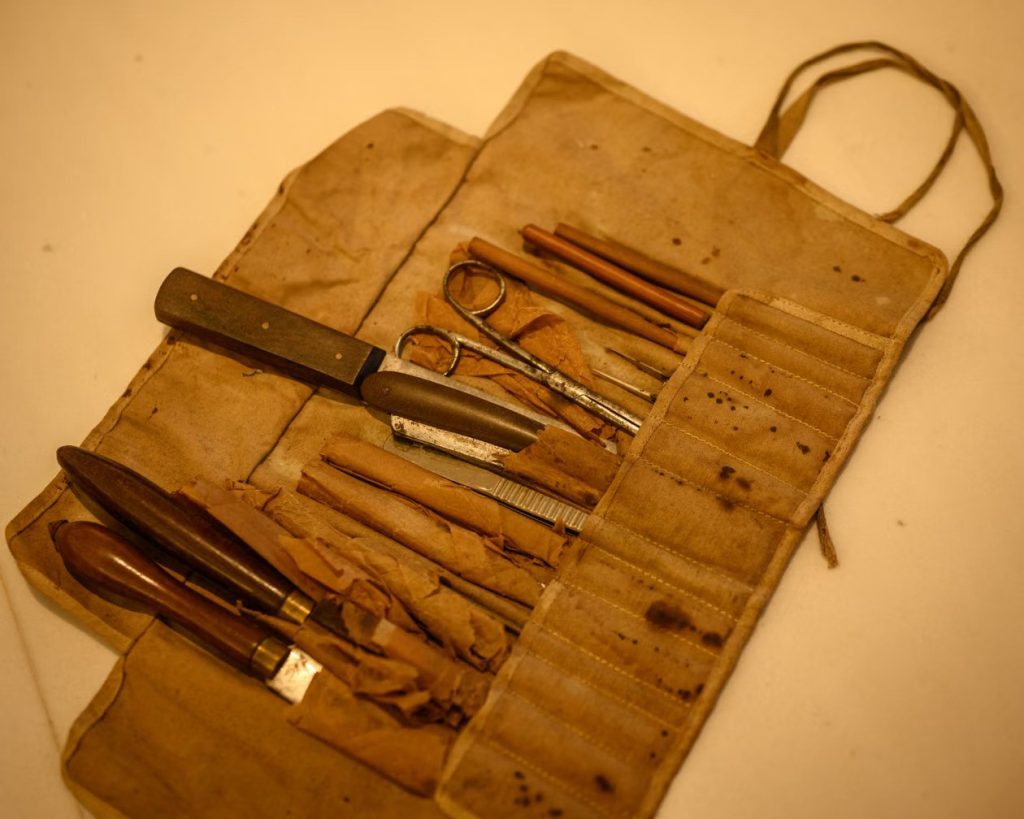
ABOVE: Surgical kit belonging to WWI physician and writer Georges Duhamel, on display at the Museum of the Great War, in Péronne, Somme.
BELOW: Notebook of Major Doctor Henri Martin from World War I, at the Museum of the Armed Forces Health Service, Val-de-Grâce, Paris.
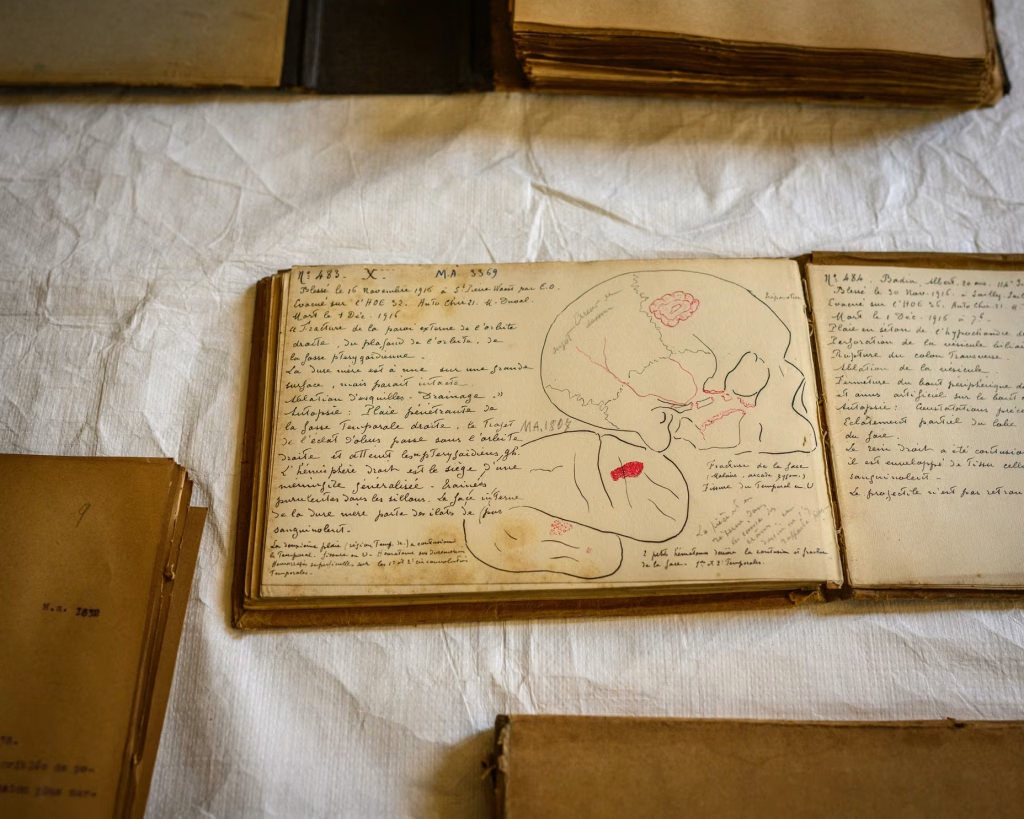
In the autumn of 1914, things finally began to change. Radiology developed, allowing for better localization of bullets and shell fragments, while blood transfusions started to be used experimentally. Above all, doctors stationed at the front realized they had to operate as quickly as possible. Small mobile hospitals known as surgical ambulances were then set up near the front lines. Over the months, thanks to accounts from these practitioners passed on to their colleagues in Paris, surgical procedures were modified.
The directive not to treat abdominal wounds – which, according to the principles of the French Surgical Society at the time, were either expected to heal on their own or inevitably lead to death – was gradually challenged in order to reduce the excessively high mortality rate on the battlefields.
At the Musée du Service de Santé des Armées, next to the Val-de-Grâce military hospital in Paris (which closed in 2016), the legacy of this medicine has been enshrined. The heritage curator was determined to restore the rightful place of the gueules cassées, whose depictions, considered too difficult to look at, had largely been relegated to the museum’s storage rooms. She said:
“A repaired face, after all, restores an identity. By displaying the heart of our incredible collection, I hope to change how visitors see them”.
There will be a major exhibition in October 2027.
Note to readers: a few years back, we were permitted into the museum’s storage rooms, where more than 700 items – drawings, casts and masks – are carefully preserved. These pieces document the long process of reconstruction for the gueules cassées, who were treated at the military hospital, either to receive grafts or to be fitted with a prosthesis that reproduced their face as closely as possible.
Some of these stored pieces had never been revealed, such as artists’ sketches depicting in detail the ravaged flesh. They were invaluable testimonies to the suffering endured on the front lines by thousands of men. During the Great War, France recorded 500,000 facial injuries, including 15,000 who were severely mutilated.
The direct, personal meaning of World War I has largely faded as living memory has disappeared, though its historical and structural significance remains deeply embedded in modern institutions. Its meaning has faded for several reasons:
• With no veterans or direct family members left to pass down firsthand accounts, the war has shifted from a living memory to a distant historical event.
• For many cultures, World War II – with its clearer moral narratives, larger global footprint, and more recent timeline – took center stage in public consciousness.
• Public polling over the years has repeatedly shown that a large percentage of the general public cannot identify key WWI battles, dates, or geopolitical catalysts.
But its meaning persists. Why?
• It reshaped the modern world. The war dismantled four major empires (German, Austro-Hungarian, Russian, and Ottoman), redrew global borders, and set the stage for the geopolitical conflicts of the 20th and 21st centuries.
• The cultural and social shifts. It catalyzed changes in technology, medicine, and the social roles of women and minorities.
• Institutional remembrance. Museums, archives, and annual observances like Armistice Day/Remembrance Day continue to preserve the structural lessons of the conflict.