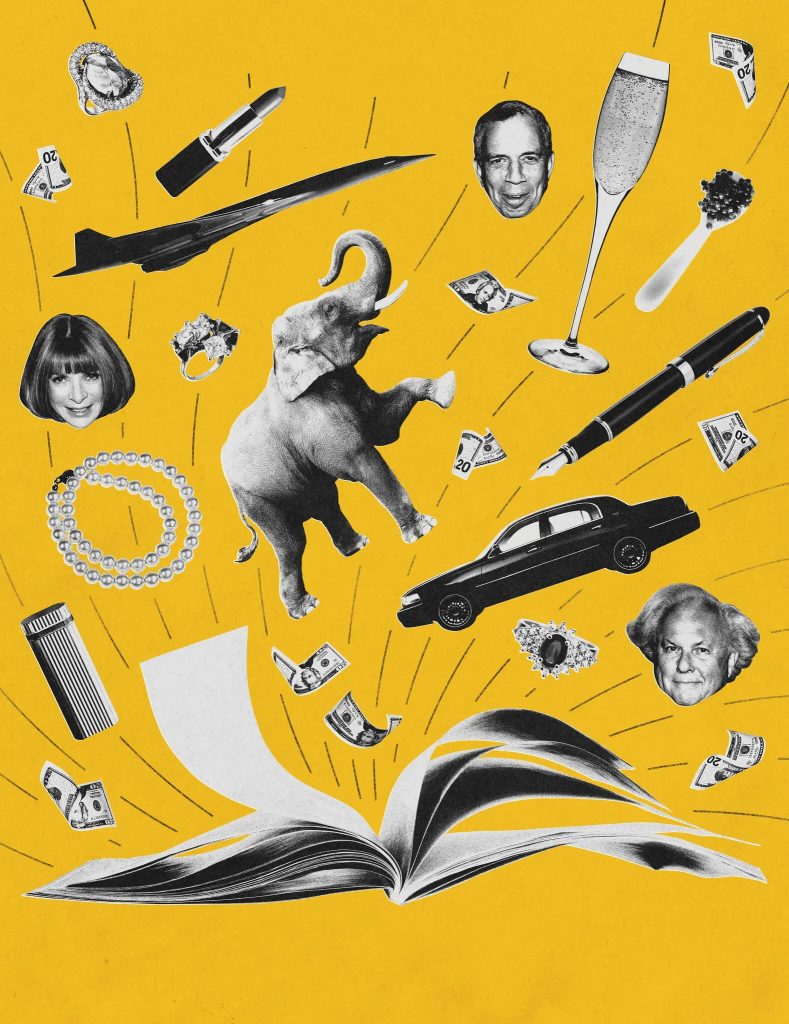
Michael Grynbaum gets it right: Condé’s editors were the original influencers, their lives a top-to-bottom marketing campaign for the company that hired them.
3 July 2025 – – While the world burns down around me, I am taking a short break from the end-of-days.
As most of my regular readers know I belong to a publisher’s consortium – a membership due to my university days when I had a long-time, part-time position as a “professional reader” of unsolicited manuscripts submitted to publishers (first for Random House and then for Simon & Schuster).
I’d read the manuscript and prepare a “no-longer-than-5-pages” summary. Later on I had the opportunity to offer my opinion on a book, and still later do a more detailed review if the editor wanted to pursue the book. It was my introduction to the media world and would inform and influence my entire career.
Through this consortium I still receive 10-15 books a month – the paperback versions sent to reviewers well before their publication. Some books stay in my library, but the majority go to my Foundation which distributes them to libraries.
Condé Nast was the big gorilla in NYC during all of this time. Its influence and reach were huge. Michael Grynbaum, who is the principal media analyst for The New York Times, has a book out later this year entitled “Empire of the Elite: Inside Condé Nast, the Media Dynasty That Reshaped America” and it is a corker.
He published an overview of the book last week which is behind the New York Times pay wall but available via my Slideshare link below.
A few excerpts from the book:
To sell his magazines’ upper-class fantasies to the masses, Si Newhouse — a mercurial connoisseur who collected Rothkos and wore sweatshirts to the office — bankrolled a kind of dream life for the workers in his employ. When Art Cooper, the editor of GQ, hosted dinners in Milan in the 1990s, he flew out his food critic for the sole purpose of selecting the wine pairings.
Ron Galotti, the Condé adman who inspired Mr. Big from the HBO series “Sex and the City,” shipped his Ferrari Testarossa to Colorado to impress an advertiser.
The photographer Irving Penn smashed a hundred Cartier glasses in pursuit of the perfect shard.
Outsiders who scoffed at this profligacy misunderstood the masquerade. Condé’s editors were the original influencers, their lives a top-to-bottom marketing campaign for the company that hired them. All those limousines and Concorde flights serviced an illusion: that the readers who subscribed and the brands that advertised could possess a piece of this glamorous world. The decadence was the point — and when it dwindled, so did the power of Condé Nast.
Today, the company is a husk of its former self. Many of its magazines have closed or been riddled by layoffs; its authority has been all but demolished by the web. When Mr. Carter’s successor at Vanity Fair, Radhika Jones, abruptly stepped down this spring, questions swirled over whether the job, once a crown jewel of journalism, was still desirable. (Some prominent editors like Janice Min said no.)
After Condé Nast purchased the pioneering tech magazine Wired in 1998, its editor, Katrina Heron, flew to New York to meet her new bosses. She was immediately chastised for booking a room at a modest Midtown hotel. At an executive’s urging, she switched to the St. Regis on Fifth Avenue, which was several times the price.
“Good,” the executive told her. “When people have breakfast with you, they want you to be staying at the St. Regis.”
Ms. Heron accepted an interest-free loan for a down payment on a San Francisco apartment. When she left the magazine three years later, nobody at the company asked her for the money back. After she sold the apartment, Ms. Heron mailed a cashier’s check to Condé as reimbursement; the accounting office called and asked her what the money was for. The company had no record of it.
Writers on assignment were encouraged to FedEx luggage to their destination, rather than schlep it on the plane. A Vanity Fair writer, reporting a story in London, lived for a month with her husband and children at the Dorchester, the prestigious hotel overlooking Hyde Park; a separate room was reserved for their nanny on the Newhouse dime.
On Thursday, another pillar shifted: Ms. Wintour stunned the fashion world by announcing she would relinquish her editorship of American Vogue, the role she has occupied for 37 years. Ms. Wintour is not going anywhere: She remains Vogue’s global editorial director and continues to oversee every Condé title, save for The New Yorker. (She also made a point of saying she would keep her current office and its Clarice Cliff pottery.)
Still, it was the first real sign of succession planning — a Condé conclave, as one editor joked — and a reminder that Ms. Wintour, arguably the last link to the company’s glory years, will not be around forever. Nowadays, magazine writers are more likely to stay at a Radisson than the Ritz. When the new editor of Vanity Fair, Mark Guiducci, starts on Monday, he will be expected to follow what was once a very un-Condé edict: do more with less.
And yet, judging by the global headlines that heralded Ms. Wintour’s change in title, the company’s legend remains a source of fascination. We still live in the world that Condé bequeathed to us: the world of the Vanity Fair Oscar party and Vogue’s Met Gala, a world obsessed with status and celebrity and consumption — a world that has persisted even as the monoculture has faded, and the only gatekeepers left to credit or blame are ourselves.
Yes, the original influencers, perhaps, but the money spent is eye-watering, and almost upsetting. The above excerpts just skim the surface of the amount of $$$$ spent.
For the full piece please click here.