There is horrific video and photographs in this post, plus a short clip from my video essay on dehumunisation, filmed at the Auschwitz death camp in Poland.
This horror should provide the world a moral moment of clarity. There are no moral gray areas in this struggle — the Ukrainian struggle against Russian power is existential.
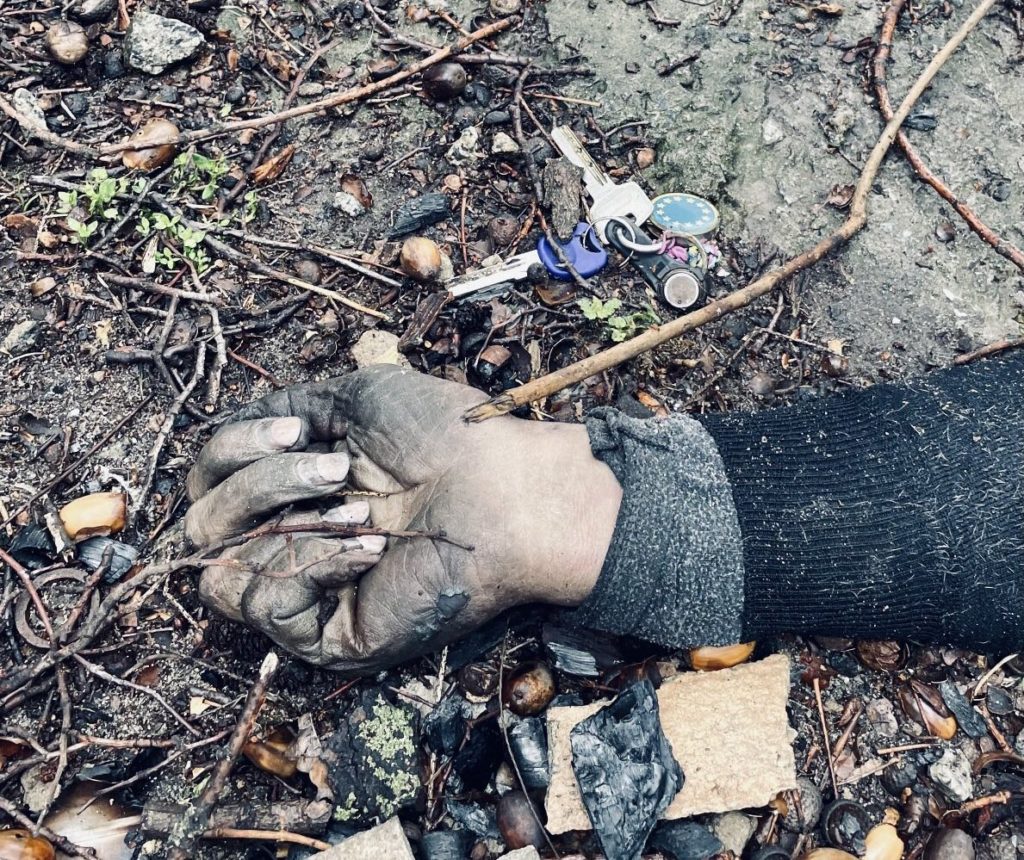
This powerful image conveys Russia’s unspeakable brutality, but it is the European flag on the victim’s key ring that speaks volumes. It reminds us that ordinary Ukrainians identity with Europe not Russia.
4 April 2022 – This past weekend I was completing my essay on the Ukraine War and military technology. Part of that essay echos the words of Jacques Ellul, the French philosopher and sociologist, who I have quoted numerous times. In the 1950s he wrote about “technique”, publishing three seminal works on the role of technology in the contemporary world. His basic thesis was that technology gives human beings more power to control their world – good and bad.
But I would add to that the price for giving us that increased power means technology fundamentally transforms the experience of human life in unexpected ways that are difficult to comprehend even after the changes have already happened. In other words, technology “complexes” our world.
Military technology, unfortunately, is part of that. If you give human beings new capabilities, some of those humans are going to use those capabilities to try to conquer and kill each other. This doesn’t mean that we should restrain the development of technology out of fear that it’ll be used for military purposes — it seems to me that new technology has made humans steadily richer and happier over time without making war any more prevalent or destructive than it was in the past.
But I was not able to finish that technology essay as more, horrifying news began to emerge from Ukraine over the weekend. As the Russian army retreated from the areas around the Ukrainian capital of Kyiv, a series of horrific atrocities were being discovered, especially in Bucza (Bucha). 1,510 bodies have been found so far (as of 12pm Kyiv time as I write this), littering the ground, often with their hands tied behind their backs. Mutilated children are among them.
This is probably just the tip of the iceberg — more bodies will be found, and Russia still controls plenty of Ukrainian territory in the south and east. From the fact that the Russians brought mobile crematoria and 45,000 body bags to an invasion they thought they were going to easily win, and distributed instructions for the digging of mass graves, it’s clear that mass killings like this were part of the invasion plan from the start. The best guess is that Putin’s intent was to decapitate Ukrainian society by executing political, cultural, and religious leaders — something like what the Nazis and the USSR did to Poland when they teamed up to conquer it in 1939, and as the Soviets did to Ukraine in “The Holodomor”, also known as the Terror-Famine or the Great Famine from 1932 to 1933 that killed millions of Ukrainians. But there is also plenty of spontaneous cruelty, like mass rapes and slaughter of dogs. In fact, before all communications with Bucha had ceased, residents were posting on Instagram and Telegram the arbitrary executions as early as 27 February. Hence you’ll understand the Ukrainian Army’s determination to take back the territory.
It’s the kind of atavistic horror we thought we had left behind in the 20th century, now reborn in the 21st.
I am sure many of you have seen some of the following photographs and video footage, or similar. Most of my material comes my OSINT network and a good many of them share their material with multiple media outlets. These initial photos are from areas around the Ukrainian capital of Kyiv.
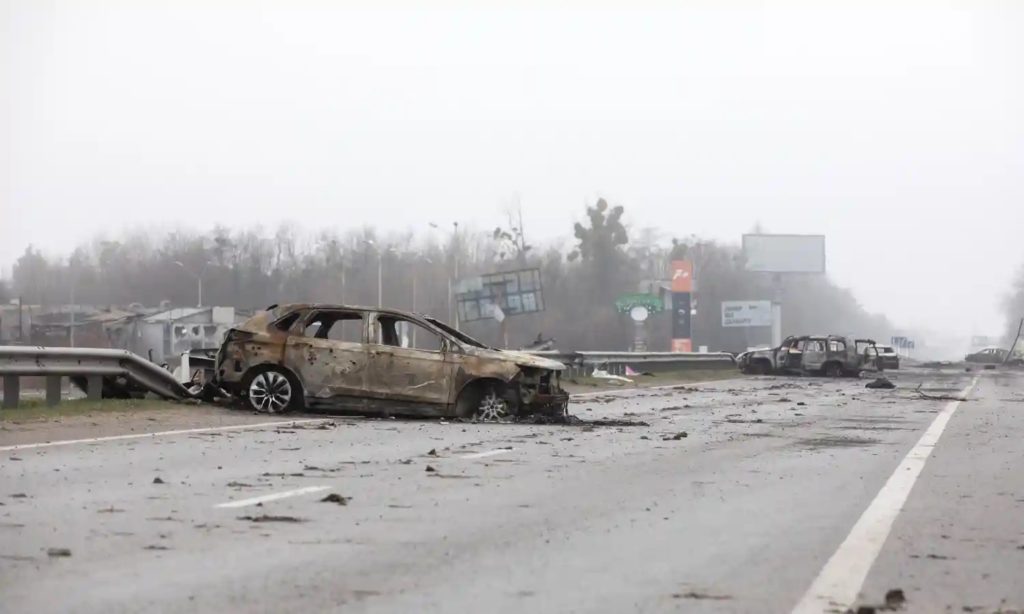
First, the general wreckage. These destroyed cars went for miles:
Worse, many destroyed cars were smashed over by tanks, some of them still contain bodies of killed civilians:
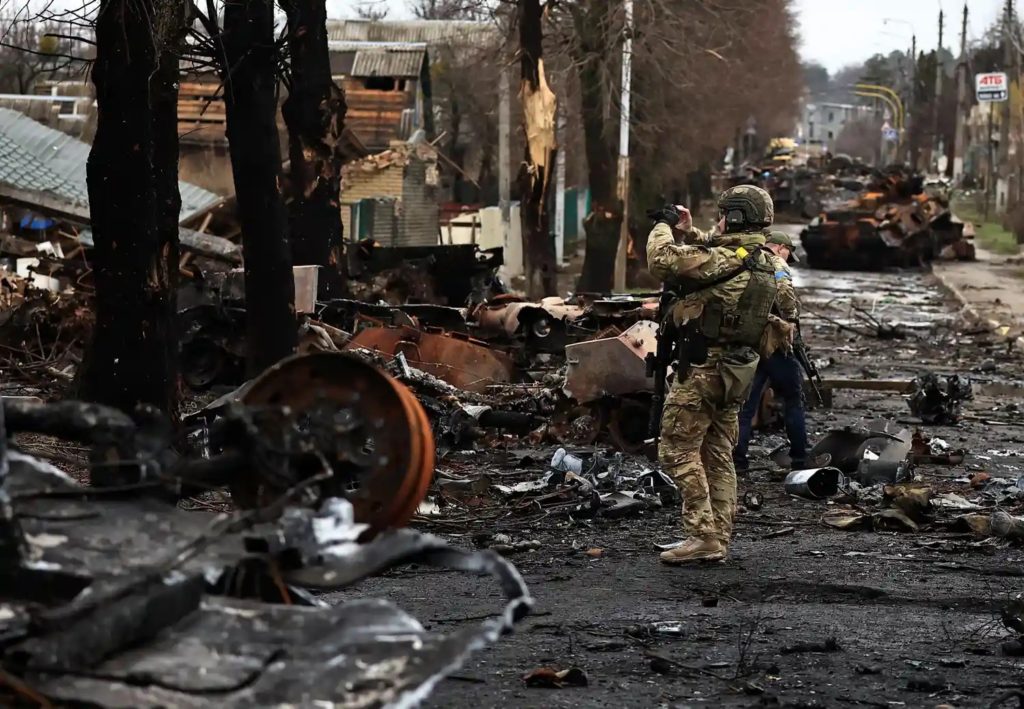
The bodies of killed civilians lay across every town the Ukrainian Army entered:
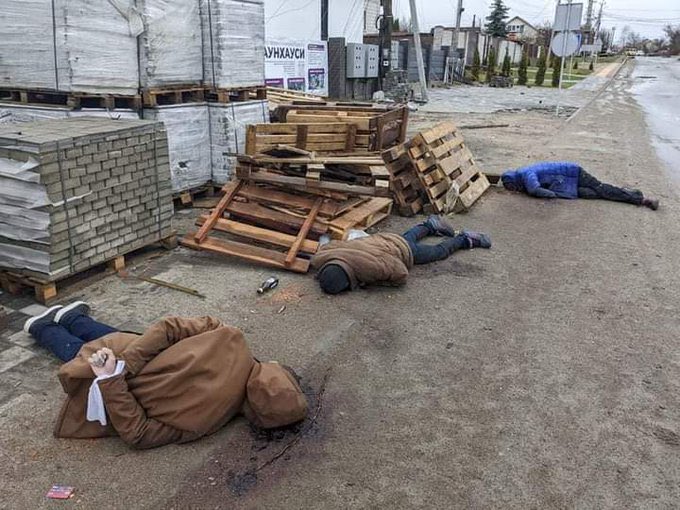
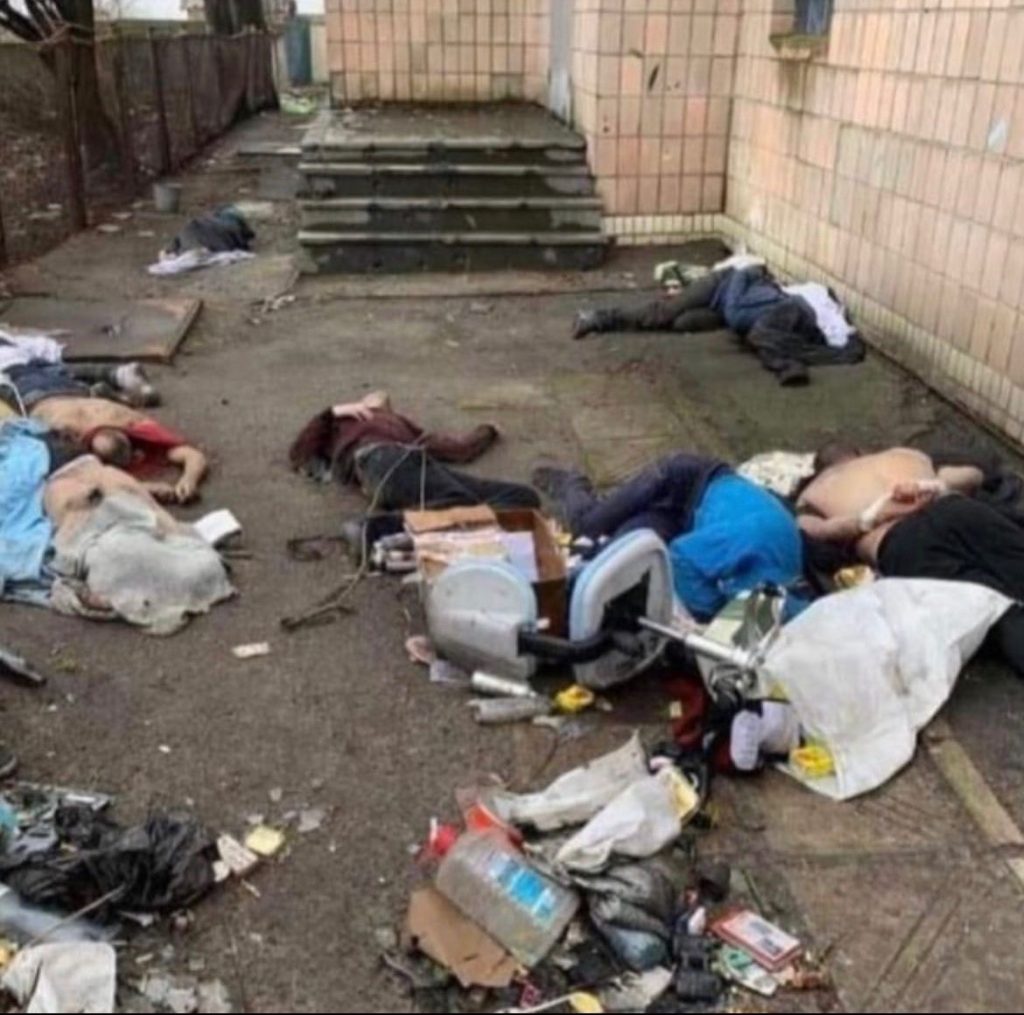
You will note in the two photos above several of the dead have their hands tied. Initial forensic reports indicate these individuals were tortured.
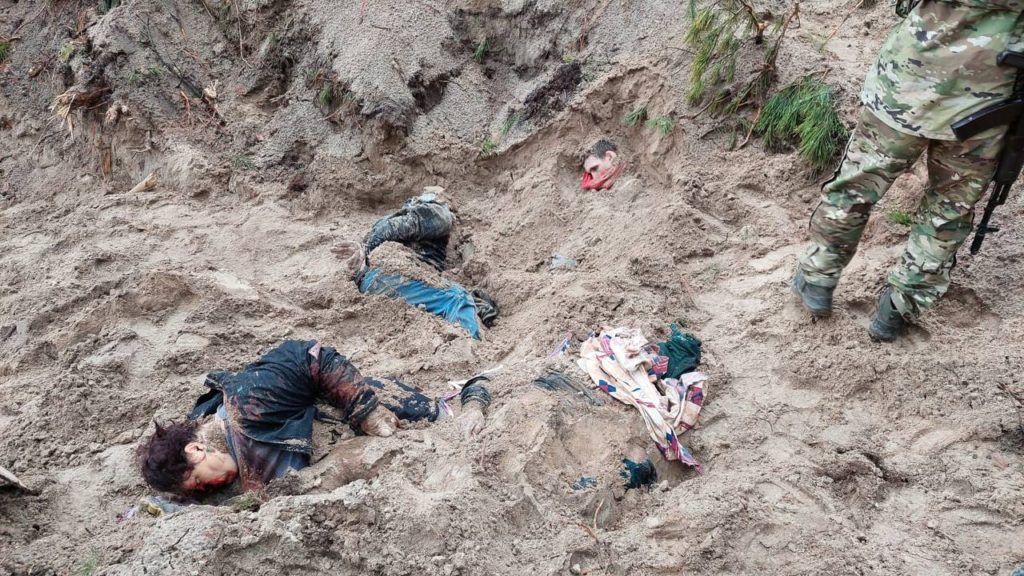
Below, Ukrainian soldiers and volunteers report finding multiple, small mass graves contains 5-8 people. One larger grave has been found containing about 300 bodies.
The following satellite view below shows a mass grave on the grounds of a church in Bucha, northwest of Kyiv. It shows a 45-foot-long trench, the image taken by Maxar Technologies.
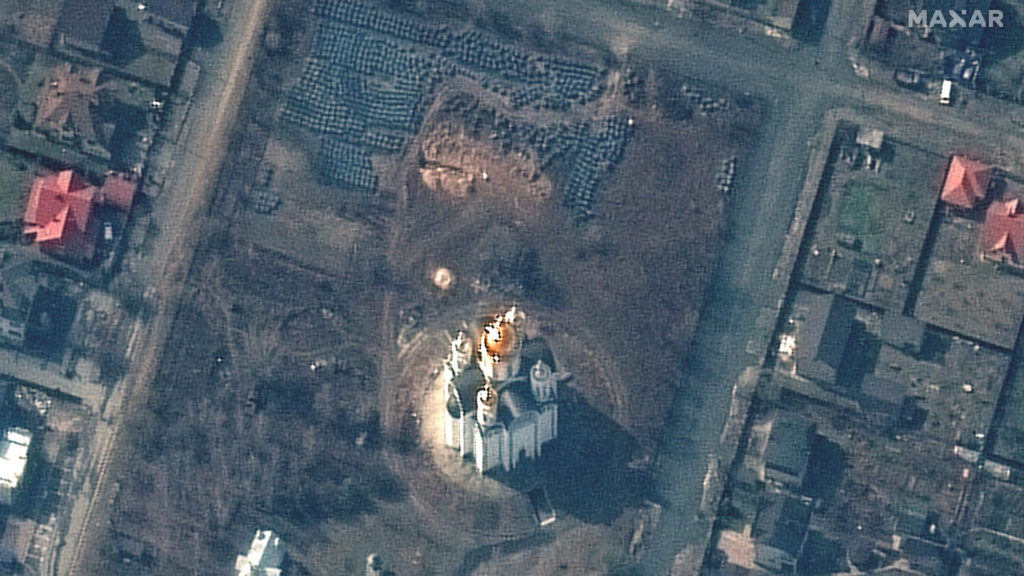
Maxar is a space technology company headquartered in the United States. It specializes in manufacturing communication, Earth observation, radar, and on-orbit servicing satellites, satellite products, and related services. I will have more about them later this week when I complete my war technology essay. But in brief they use a satellite software program that takes high-resolution imagery to see if there’s any visible signs of ground disturbance and to establish when such disturbance was dug. Maxar first picked up the excavation on 10 March.
Journalists who visited Bucha over the weekend said the mass grave was still open, with hands and feet poking through red clay heaped on top.
All of these scenes are reminiscent of the Srebrenica massacre during the 1990s war in Bosnia – and have triggered calls for a renewed, no-holds-barred Western response. And these images have also sparked fears about the horrors yet to be uncovered in other areas of Ukraine occupied by Russian forces, including the besieged port city of Mariupol.
Over the weekend a BBC reporter filed this report and you’ll fully understand the depravity unleashed:
One last battle video. A Russian tank/paratrooper unit, alleged to have been one of Russia’s crack teams, was assigned to carry out a landing and seizure of Gostomel airfield, a critical cargo airport in the northwestern suburb of Kyiv. But they were ambushed by a Ukrainian Special Forces team, and almost completely wiped out. Here is a clip posted on Youtube by someone in my OSINT network:
They had been detected via intercepted communications. Several points:
1. The bodies of 100s of Russian soldiers have been left behind. The Russian military has a different ethic than the U.S. military about recovering their dead.
2. Internal Russian military communications that have been intercepted by U.S. intel indicates they are being counted as “missing in action”. It goes to the casualty estimates for Russian forces, looking at the extent of the destroyed equipment, the bodies of Russian soldiers being recovered by Ukrainian forces, etc. Right now U.S. intel is showing a killed-in-action figure of 11,000+. I will provide a detailed analysis of how all of this is computed/estimated based on a interview I had with an ex-U.S. Army colonel who was once tasked with estimating those very things.
3. Russian social media indicates that many funerals are happening more than a month after soldiers have died, causing fatigue and frustration amongst families and that aspect needs some attention which I will try to incorporate in #2 above.
4. And, lastly, one must also remember that when an armored vehicle is hit with a missile, the inside of that vehicle burns incredibly hot, the ammunition inside cooks off, and many of the crew bodies are vaporized or just ashes. Ukrainian and U.S. intel knows what the size of the tank crew should be but in many cases a full crew is not being deployed.
Genocide begins with dehumanisation

Dehumanization fuels the worst brutality that human beings perpetrate against one another. It’s not just a problem of the modern industrialized world. It’s haunted humanity for millennia. Genocide is the most disturbing example of dehumanization‘s destructive power.
The following is a short clip from a longer video essay I am producing on dehumanisation, a series of pieces that will be collateral to my upcoming film “A Blind Man’s Vision of the Dark Side: The Extraordinary Life of Jacques Semelin”, a look at massacres, genocide, the Holocaust and much, much more as seen through the work of preeminent historian Jacques Semelin. You can read a background on the film production by clicking here.
We filmed this piece at the Auschwitz death camp in Poland where we spent 2-days completing principal filming, courtesy of the Auschwitz Memorial center which allowed us to film early morning before the general public is allowed to visit the site:
There is more and more evidence that genocide was the plan from the start. It’s even more than that. It’s “ethnocide” given the intent seemed to be focused on erasing Ukrainian identity, leadership and nationhood – village elders and politicians and veterans and anybody in leadership being the ones to be erased.
Read the posts and distributions the Russian state news agency RIA Novosti (translated for me by our Russian/Ukraine team) broadcast to Russians and issued to every Russian soldier, as well as lectured to every soldier by their commanding officers. You’ll find:
“Denazification is a set of measures aimed at the nazified mass of the population, which technically cannot be subjected to direct punishment as war criminals”
“However, besides the elite, a significant part of the masses of the people, who are passive nazis, are accomplices to Nazism. They have supported the Nazi authorities and indulged them”
“The just punishment for this part of the population is possible only as the bearing of the inevitable hardships of a just war against the Nazi system”.
“The name Ukraine can seemingly not be retained as the title of any fully denazified state formation on the territory liberated from the Nazi regime”
“Denazification is inevitably also deukrainisation – a rejection of the large-scale artificial inflation of the ethnic element of self-identification of the population of the territories of the historical Malorossiya and Novorossiya begun by the Soviet authorities”
“Unlike, let’s say, Georgia or the Baltics, Ukraine, as history has shown, is a non-viable, never existing national state, and it attempts to build one logically from Nazism”
“The Banderite Elite [note: The Banderites are members of an assortment of right-wing organizations in Ukraine] must be liquidated, as reeducation is impossible. The social swamp which actively and passively supports it must undergo the hardships of war and digest the experience as a historical lesson and atonement”
All of the material continues in this vein.
TO CONCLUDE THIS EDITION …

The horrifying images and testimony that emerged over the weekend made it ever so clear that Putin has operated by a strict playbook in the north of Ukraine as with elsewhere in the country that has served him well for decades, albeit at a heavy cost to his army. Putin’s attack on the Chechen capital, Grozny, in 1999, was as unsuccessful as the attempt to decapitate Ukraine’s leadership in Kyiv within a few days of his 24 February invasion. But he made brutal corrective moves in Grozny which the United Nations called “the most destroyed city on Earth in 2003”. Between 5,000 and 8,000 civilians were killed during its siege, the exact number never to be known.
During the 2016 battle of Aleppo, Russia seized back rebel-held areas of the city for Syria’s President Bashar al-Assad through a month-long aerial bombing campaign, killing men, women and children. There are 51,731 documented killings in that city alone. In the UN’s first full report of Syria’s 10-year war (issued in September 2021) it said 350,209 people have been killed but admitted the tally could be an “undercount”.
Putin’s belief? Indiscriminate use of artillery, potentially resulting in the total destruction of a city, will bring a people to its knees. Blanket bombing of civilian targets, alongside the false offer of humanitarian corridors that give and then cruelly dash hope. Infrastructure demolished, hospitals, bomb shelters and schools targeted.
And his other belief? If you have nuclear weapons you can lay waste to any country you wish.
That does require a level of cynicism and weakness from the West that Putin has long believed is a banker: that the US and the EU will draw a blind eye to what has happened given the intractability of the new normal.
As I noted above, genocide is only possible when dehumanisation happens on a massive scale. The perfect tool for this is propaganda. That is Putin’s tool. It keys right into the neural networks that understand other people, and dials down the degree to which we empathise with them. We’ve seen how our brains can be manipulated by political agendas to dehumanise other people.
As I learned from Jacques Semelin, traditionally we examine warfare and killings in the context of history, economics, and politics. That is all important. Ukraine’s national origins can be traced back for over a thousand years, but Putin refuses to acknowledge that Ukraine is a nation at all. Instead, he disavows its history, language, culture, and religious traditions while publicly insisting that Ukrainians are in fact Russians. Since he does not accept Ukraine’s right to exist, his entire understanding of the country is hopelessly distorted.
Such thinking is by no means limited to Russia’s current leader. On the contrary, denial of Ukrainian statehood and identity is deeply rooted in modern Russian society, reflecting imperialistic instincts that make it impossible for many Russians to accept Ukraine as anything other than a component part in their own country’s national narrative.
But for a complete picture, you must understand this as a neural phenomenon. It would normally feel unconscionable to murder your neighbor. So what suddenly allows hundreds or thousands of people to do exactly that? What is it about certain situations that short-circuits the normal social functioning of the brain? To understand something like violence or genocide, we need to drill down one step further, to dehumanisation.
And that is a subject I have only skimmed in this post but hopefully I have laid a foundation. I will return to it in more detail – both in my film, and in a detailed video, and blog post.
That understanding is critical to understanding our history. All across the globe, groups of people repeatedly inflict violence on other groups, even those that pose no direct threat. The year 1915 saw the systematic killing of more than a million Armenians by the Ottoman Turks. In 1994, over a period of 100 days, the Hutus in Rwanda killed 800,000 Tutsis, mostly with machetes.
After the Holocaust, Europe got into the habit of vowing “never again”. But between 1992 and 1995, during the Yugoslav war, more than 100,000 Muslims were slaughtered by Serbians. One of the worst events of the war was in Srebrenica in July 1995 when, over the course of 10 days, 8,000 Bosnian Muslims – known as Bosniaks – were shot and killed. They had taken refuge inside a United Nations compound after the town was surrounded by siege forces. But the UN commanders expelled the refugees from the compound, delivering them into the hands of their enemies. Women were raped, men were executed, and children were killed.
I know. “Never again”. Anne Frank, in one of her last diary entries shortly before she and her family was arrested, and roughly 1 year before her death:
“What is done cannot be undone, but one can prevent it happening again.”
The Ukraine should provide the world with its moral moment of clarity. There are no moral gray areas in this struggle – the Ukrainian struggle against Russian power is existential. At the very least, the U.S. and European countries should provide the Ukrainians with any and all of the weapons they need – tanks, rocket launchers, air defense, planes, etc. – to expel the Russians from the rest of Ukraine as quickly as possible, so as to save as many Ukrainian lives as can be saved.