Reminders that the complexity of the world grows geometrically while our ability to handle problems grows perhaps arithmetically. Though we’re pretty good at dividing into zero, just by using large bombs.
5 March 2026 (Athens, Greece) – Depending on your timeline, you may have already read some of this news. But my guess is your timeline is not saturated with stories of war, genocide and dystopia as mine is. And I elected that. Go figure.
Some stuff to ponder.
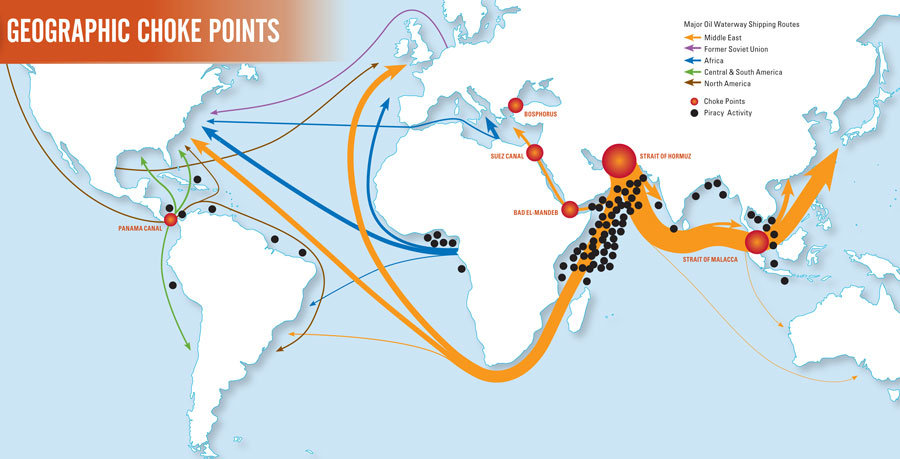
Big Tech’s Gulf mega-projects are now trapped between two war choke points. The U.S.-Iran conflict has closed the only two routes for data in and out of the region.
Billions of dollars in U.S. technology infrastructure, and trillions more in planned investment, now depend on fiber-optic cables running through war zones. Amazon, Microsoft, and Google spent years building data centers across the Gulf, betting the region would become the world’s next great hub for artificial intelligence.
The undersea cables connecting those facilities to Africa, South Asia, and Southeast Asia pass through two narrow passages: the Red Sea and the Strait of Hormuz. Both are now effectively closed to commercial traffic.
Iran’s Islamic Revolutionary Guard Corps declared Hormuz shut on March 3rd, threatening to “set ablaze” any vessel attempting passage. At least 5 tankers have been damaged and roughly 150 ships are stranded around the strait. In the Red Sea, Houthi militants announced they would resume attacks on shipping in solidarity with Iran, ending a ceasefire that had held since late 2025.
The war that began on February 28th has turned both choke points into active conflict zones simultaneously – something that has never happened before.
Now, about 17 submarine cables pass through the Red Sea, carrying the vast majority of data traffic between Europe, Asia, and Africa. Additional cables run through the Strait of Hormuz, serving Iran, Iraq, Kuwait, Bahrain, and Qatar. If any are severed, the specialized repair ships can’t safely reach either passage.
And Iran can “snip” those cables, with ease.
The director of internet analysis at the network intelligence firm Kentik, and a friend of mine, was interviewed on the BBC last night. I have written about Kendrick before. They have this fantastic network intelligence platform for modern infrastructure teams that can map network observability, performance, and security. They monitor, run, and troubleshoot complex, hybrid network environments.
During his interview he said:
“Closing both choke points simultaneously would be a globally disruptive event. It has never happened before. When Amazon, Microsoft, and Google were spending years and billions of dollars building these data centers across the Gulf – and trillions more planned – we said ‘But if a war comes to this region, all bets were off’. We were told ‘Nah, our tech is impervious to that’.
Hmmm – I guess not”.

The Pentagon is now seeking Ukrainian interceptor drones to counter Iran. It seems the math isn’t mathing. So a little math for you as Operation Epic Fury enters Day 6.
Iranian Shahed suicide drones are swarming Gulf airspace. They’re targeting military bases and infrastructure. Russia has been using Shaheds against Ukraine for 3.5 years. And Ukraine knows how to deal with Shaheds cheaply.
• a Shahed-136 costs roughly $20k–$50k
• a Patriot PAC-3 interceptor costs about $4–6 million
• a THAAD (the granddaddy, the Terminal High Altitude Area Defense missile, a very complex anti-ballistic missile defense system) can exceed $10 million per shot
This is asymmetric warfare by design — forcing defenders to burn gold on aluminum.
In parts of the Middle East today, Patriots are intercepting slow propeller drones because there is no cheaper defensive tier available.
But a $5M missile fired at a $30k drone weakens ballistic missile coverage. That is the strategic trap.
We’ve seen what happens when swarms get through. Oil infrastructure in Saudi Arabia has faced drone strikes. U.S. facilities in the region have reported impacts on installations like sensors and radar systems.
Ukraine adapted differently. They do not waste Patriots on Shaheds. High-end systems are reserved for ballistic missiles. As I explained in one of my Ukraine war posts, drones are countered with layered tools:
• mobile fire groups
• EW (electronic warfare)
• heavy guns
• interceptor drones
• passive radars
Russia has launched hundreds of Shaheds in single nights against Ukrainian cities and power grids. Ukraine’s interception rates during mass attacks have often exceeded 80–90%. Because they built cost-effective architecture.
If “Epic Fury” continues under this saturation, partners in the region do not just need more Patriots, but layered, asymmetric, scalable defense. As one U.S. War Department email let slip (leaked by somebody): “We need the Ukrainian drone defense doctrine. We can’t afford shooting down $20k drones with $4 million missiles”.
Hmmm. Wasn’t it in that now infamous 2025 meeting with Ukrainian President Zelenskyy where Trump said: “If you didn’t have our military equipment this war would have been over in two weeks”.
But now you need cheap Ukrainian drones to defeat Iran? Who has the cards now?
Oh, the hubris. Imagine the U.S. having to fight a conventional war against another opponent at the same time as what’s happening now. It’s clear that the Pentagon budget is just a device for scamming tax money for the military industrial complex, building vastly over expensive and complicated weapons systems that are nigh on impossible to protect for a reasonable cost – and cannot deliver quantity.
The cognitive dissonance surrounding the common take that Russia’s (and now Iran’s asymmetrical) attritional war tactics are stupid is still pretty astounding.
No wonder the Chinese have been manufacturing vast, vast quantities of cheap and very effective munitions over the last few years, and of course have an industrial base that is far more impressive than anyone else. The rampant hubris about “the unbeatable U.S. war machine” and thinking really is something to behold.
Hmmm. So someone didn’t get the email on what the war in Ukraine taught us a few years ago. That:
• warfare has changed with the use of cheap drones, and
• it isn’t sustainable to use fancy Patriot rockets to down cheap drones
So now, every military bureaucrat around the globe is scrambling to buy cheap interceptor drones.
And the irony continues because the nature of war is changing fast. It takes 10 years or more to develop new “state-of-the-art” high-tech aircraft, submarines, ships, and missiles. Meanwhile, Barney and Fred are knocking up weapons in their sheds and making those weapons obsolete.
The issue, of course, is it all depends what type of war you’re fighting, your course of action, what stage you’re in and what your end-goals are. See the video directly above.
The U.S. and Israel are simply carpet bombing apartment buildings one after another, filled with families, in an urban center the size of New York City.
The narrative? We’ll just bomb the shit out of Iran and it will collapse, because any second now it will run out of munitions and not be able to defend itself.
This will be the same destructive bombing campaign as Gaza. Genocide at full scale.