We forget the fragility of our existence: we forget that we are all in the ghetto, that the ghetto is fenced in, that outside the fence are the lords of death, and a little way off the train is waiting for all of us.
– Primo Levi
If the solidarity of mankind is to be based on something more solid than the justified fear of man’s demonic capabilities, if the new universal neighborship of all countries is to result in something more promising than a tremendous increase in mutual hatred and a somewhat universal irritability of everybody against everybody else, then a process of mutual understanding and progressing self-clarification on a gigantic scale must take place. I do not see that happening.
– Hannah Arendt
Think of the vast amount of brutality, cruelty and lies which are able to spread over the civilized world. Do you really believe that a handful of ambitious and deluding men without conscience could have succeeded in unleashing all these evil spirits if their millions of followers did not also share their belief?
– Sigmund Freud
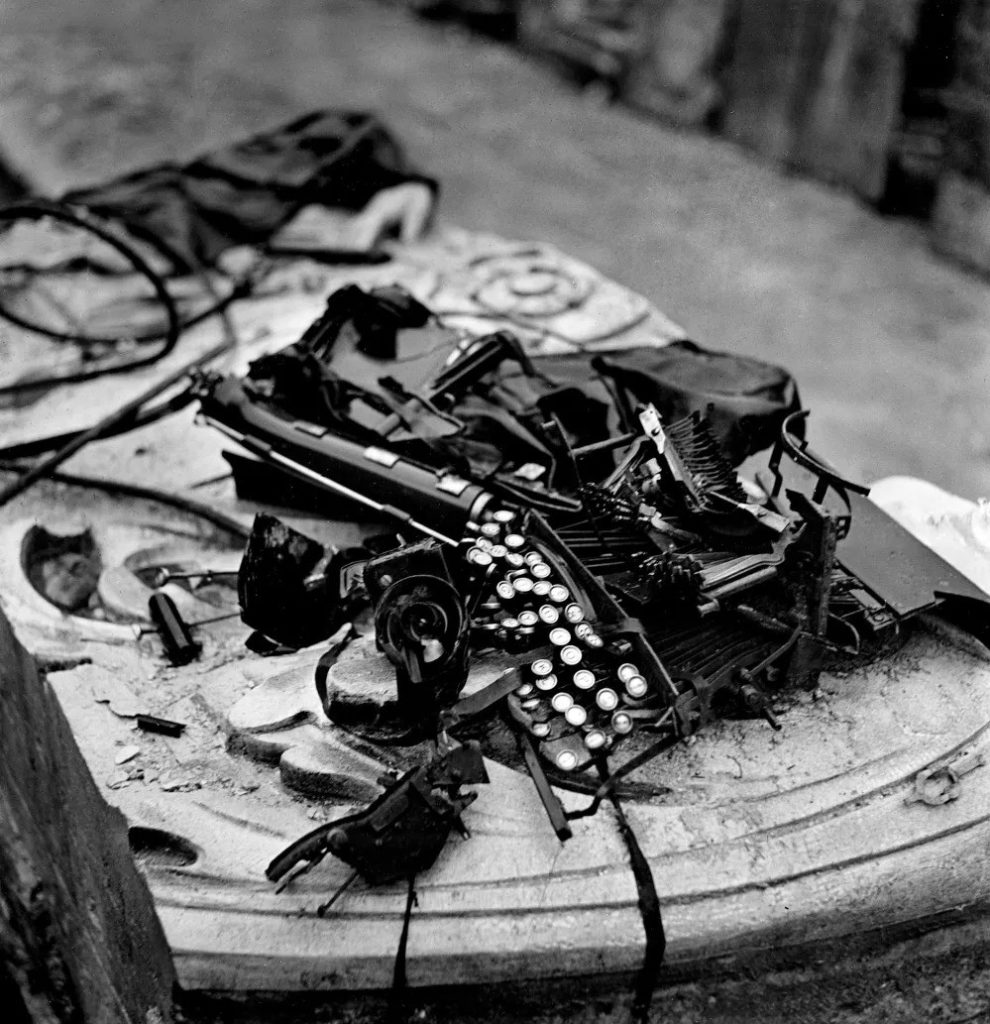
Above: The photo is by the renowned photographer Lee Miller. It is entitled “Remington Silent” and Lee shot it in 1940. The photograph is stunning. I saw the original print a few months ago at a Lee Miller exhibit in London, one of the largest presentations ever presented about her work. Remington had produced a special “Noiseless” typewriter model, marketed for its quiet keystrokes, and they made 2 special editions just for her.
22 December 2025 (Madrid, Spain) – Miller, who delighted in word play, turns this shattered typewriter into a pun on the brand name. The image draws attention to the sculptural qualities of the broken machine. It offers an abstract representation of the war’s destructive energy. A number of years ago I bought a special print of the photo from the museum/workshop her son set up to memorialize her work. She is a legend in so many worlds: the modeling world, the art world, the photography world and the journalism world. She is one of my inspirations.
The story of journalism that we’re living through at the moment is complicated. Its plotlines and characters are often messy, noisy, and wearying. Much is blamed on the dearth of objectivity. As I have written, sadism has become a media spectacle and the truth holds little value in our age of distraction. It is no mere coincidence that as the facts of our world become ever bleaker, our technology and popular culture increasingly encourage a flight from the demands of reality.
I’m not sure that’s all of the problem, or some new problematic source. EB White said in 1956:
“I have yet to see a piece of writing, political or non-political, that doesn’t have a slant. All writing slants the way a writer leans, and no man is born perpendicular, although many men are born upright. The beauty of the American free press is that the slants and the twists and the distortions come from so many directions, and the special interests are so numerous, the reader must sift and sort and check and countercheck in order to find out what the score is”.
Revisiting that recently, I wondered if White had presaged the very-online news consumption mode that many of us — especially my non-journalist friends — embrace. The reality now is one in which the distortions are so pervasive that every individual, not just reporters, is passing media (typed, filmed, posted, whatever) through an individual sieve. Including what ChatGPT spits out, in deluges of robo-speak bullet points.
On top of that, Donald Trump’s attacks on the media have been relentless and unprecedented. He and his administration have defunded NPR and PBS; banned The Associated Press from certain events because it refused to call the Gulf of Mexico the Gulf of America; dismantled the Voice of America; sued media companies; insulted journalists with degrading names; criticized late-night hosts; kicked reporters out of the Pentagon; and labelled everything they didn’t like about coverage as “fake news”. A year ago we all asked if Trump would go after the press, seeking to force them to comply with his presidency or face harsh consequences? He answered in short order. And it has been way worse than our greatest fears. We’re just one year into Trump’s second term, with three more to go, and there’s no indication that Trump will ease up on going after the press. These are dark days for the press and the U.S.
But we soldier on.
One of my journalism professors – John Bennet, an editor at The New Yorker for more than 40 years and a professor at the Columbia Journalism School for 20-something years – had lots of aphorisms for reporting and writing. One of my favorites is:
“The bias of journalism is coherence.”
It’s tempting to define this era of journalism as the Trump years and to address the specific harm he has caused the press.
But Trump doesn’t get all the blame or the credit; our story is not his to own. We could focus on the global crisis that has emerged as misinformation collides with authoritarianism. Or other turmoil related to tech – the collapse of news publishing’s advertising market, for instance.
But these, or any single idea, can’t neatly fit everything on its plate. And it’s not like there’s only doom and gloom (unless, of course, if you read only my musings and screeds 😎 ) so, as ever, journalists are imaginative, resourceful, and driven to do their work some way, somehow.
As 2025 ends it is defined by yet more abject and ignoble political, economic, technological and environmental derelictions of dire proportions. Acts of war have bombarded our screens in real time, the Earth reached its first “catastrophic” climate tipping point, and the U.S. has perniciously slid towards autocracy under Donald Trump. Meanwhile the tech billionaires who have aided this decline grow ever richer and more powerful on the theft of our intellectual capital. Under the weight of such bleak realities, feelings of hopelessness and helplessness can arise. Faith in mankind – in goodness and kindness – is threatened.
And you see it when you look at the Word-of-the-Year selections that dictionaries and other outlets are selecting. I see “slop” and “rage bait” and “parasocial” and “vibe coding” – picks that trace an internet-era feeling of exhaustion, skepticism — and figuring out what’s real.
In such times it can be tempting to look away and seek escape. Alternatively, we can face our fears and threats, stoke resistance and nourish understanding through the knowledge that reading can foster. Through books, people can seek both escape and wisdom. And this year I have kept pace, sticking to my habit of 3 books a month above my daily reading habits for work – a skill my mother instilled in me when I was 12 years old.
As I wrote earlier this year, we’ve entered the “post-news era”. Your reality – how you see the world – is no longer defined by “the news”. Instead, it’s shaped by the videos you watch, the podcasts you listen to, the people you follow on social media and know in person, and the reporting you consume. We’ve entered a period in which everyone has their own individual reality, usually by age, profession, passions, politics and platform preferences. It is what I called the “shards of glass” phenomenon that shows how attention is shattering into countless pieces.
So today, not an end-of-year essay around one theme. I merely wish to list snippets/snapshots/”shards of glass” of themes and moods and feelings and impressions that captured me over the past year, from my readings and daily observations, many of which I have written about at length this past year, and many that I will write about in 2026.
So, here are those shards, in no particular order, although I shall try to group them – knowing none of these are in their own silo. You need to get out of your usual lanes, and cross disciplines, and cultural boundaries. See more in the first piece below:

▶︎ Reading is dying. This year, as screens and social-media apps continued to fragment our attention, it felt like we finally began to grasp that there is a crisis at hand. Over the summer, the journal iScience published a study by researchers at the University of Florida and University College London which analyzed how people across the United States and the UK – cumulatively nearly a quarter of a million, across twenty years – spent their time during a 24 hour window. The data for 2023, the most recent year covered, showed that participants spent an average of 16 minutes “reading for pleasure,” which included reading a magazine, book, or newspaper; listening to audiobooks; or reading on an electronic device. That figure, however, partially obscured a more striking finding: only 16% of the respondents read for pleasure at all during the day that was surveyed. In 2004, that figure was 28%. It is the trend line that is most alarming: in the past two decades, daily reading for pleasure has declined by about 3% per year. It is a sustained, steady erosion, one that is unlikely to reverse itself anytime soon.
Oh, the complexity of the world. And the faux social environment that rewards simplicity and shortness, and punishes complexity and depth and nuance. I simply detest it. To understand the world you need to step outside your usual lanes, and cross disciplines, and cultural boundaries.
And I get it. It ain’t easy. I realize that many of my readers are “commerce monkeys, commerce machines” (not my turn of phrase – provided by a long time reader) – with barely enough time to read and write and produce for your jobs. You barely have time to scan and parse social media to keep up-to-date. I know. I know.
But you need to take the time. To be an informed citizen is a daunting task. We move through myriad, overlapping spheres, ones that are forever entangled. Moving at an exponential pace – living through social and technological change on the scale of the Agricultural or Industrial Revolution. But occurring in only a fraction of the time.
But still, though everything seems broken, we must still struggle with “why”, to struggle to understand – to struggle to survive.
▶︎ Although perhaps by not reading, by switching off, the concept of “inner emigration” is a survival solution. The tradition of “inner emigration” evolved in both Nazi Germany and Stalinist Russia as a coping mechanism under totalitarianism. Unable physically to flee their country, many emigrated “internally” instead. Your interior world matters far more than the external world.
For a nation, no less than for an individual, life consists in huge part of not thinking about things. It just feels transgressive to say so in a culture that would have us “process” everything.
Of course, the price of looking away, of what has been called “defective imagination”, is that malign forces in the world go unchallenged. Better to engage. But there is a major mistake in this argument. It overrates how much sway we have over events. The most that most people can do about the deteriorating world is to vote sensibly every few years. If fellow citizens do otherwise, that in itself is beyond your control. But more bluntly, your first duty is to your own sanity. Out there this winter, in the shopping, the drinking, the theatre-going, I no longer see mindlessness but the ultimate calculation of self-preservation.
Although to be honest, perhaps strategic withdrawal is better than performative resistance that accomplishes nothing while painting targets on our backs.
▶︎ Many of us sense, too, where societies are heading. The ultimate destination of our technological developments – from smart phones to social media – that have atomized and pacified us over the past two decades is absolute control over our lives through surveillance, facial recognition and more militarized and robotic policing, and our ever-greater redundancy and powerlessness in the face of artificial intelligence and greater mechanization.
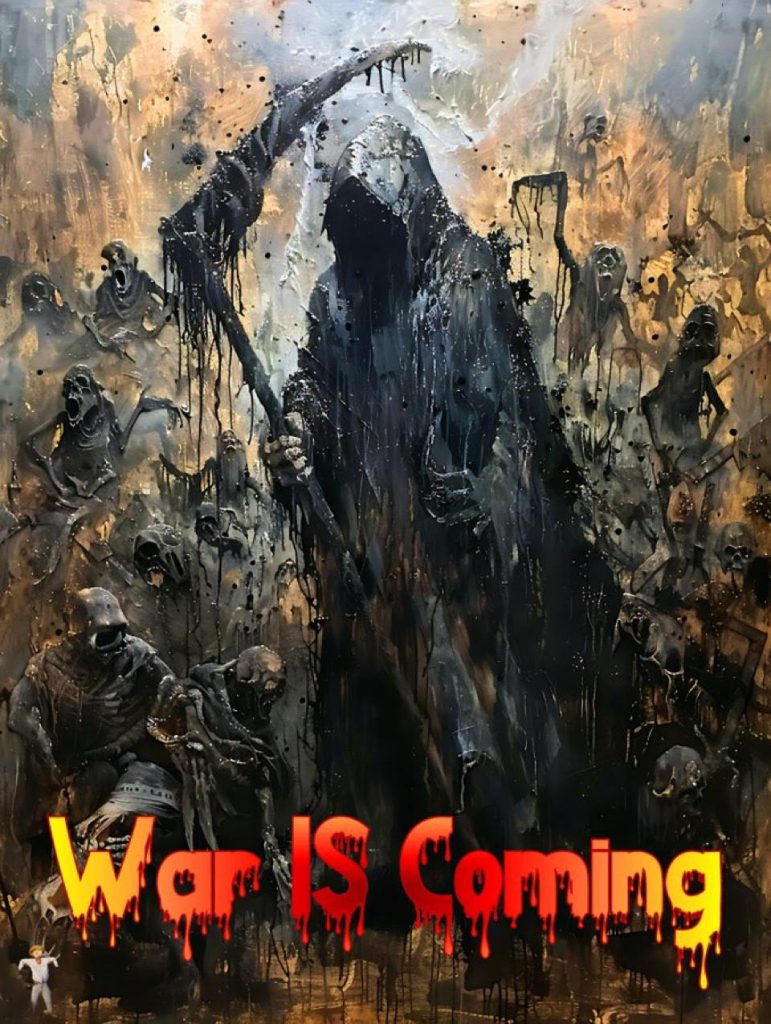
▶︎ As I wrote over the summer, America’s allies now realize a new world order: the U.S. creates more problems than it solves. It has become a negative force globally. As Trump disrupts long-standing relationships, skepticism among allied leaders have seeped into public sentiment.
▶︎As I wrote at the start of the year, the defining issue of the 21st Century is the validation of war crimes by superpowers. And as I have written so many times before, we have forgotten our history – assuming anybody has actually read it. The arc of the moral universe does not bend toward moral progress and justice. Freedom, democracy, liberalism are mere blips on the screen of humanity. Autocracy, totalitarianism and dictatorships have long ruled the roost. The emergence of liberal democracies was associated with ideals of liberty and equality that seemed self-evident and irreversible. But we know know those ideals were far more fragile than we believed. Their success in the 20th century depended on very unique social, political and technological conditions – that have now proved ephemeral, all now evaporated. History is contingent, and the sand pile we live on shifts and collapses at any moment as each new event, like another grain, is added to it. Yet these shifting sands rest upon deeper tectonic plates that shaped the overall unfolding of Western history – and surely American history for at least the last 40 years.
▶︎The war in Gaza will eventually recede into the past, and time will flatten its towering pile of horrors, just as happened/is happening to the Shoah according to the Israeli-American holocaust/genocide scholar Omar Bartov who I had the opportunity to meet last year. But, like the Shoah, signs of the calamity will remain in Gaza for decades: in the injured bodies, the orphaned children, the rubble of its cities, the homeless peoples, and in the pervasive presence and consciousness of mass bereavement. And those who watched helplessly from afar the killing and maiming of tens of thousands on a narrow coastal strip, and witnessed, too, the applause or indifference of the powerful, will live with an inner wound, and a trauma that will not pass away for years. I have a separate note on Gaza in my “Coda” at the end of this post.
▶︎And the bigger issue? Over the course of the past two years, Jews have been murdered across five continents, and many other attacks have either been foiled or taken place without loss of life. To gather together to mark the milestones of Jewish life — whether festivals of sorrow and contemplation, like Yom Kippur, the site of an attack in Manchester, or those of joy and optimism, like Hanukkah, now the site of an attack in Sydney — has become an activity fraught with unease. As Omar Bartov (whom I noted in the above paragraph) has said what has happened in that Israel has made inseparable the conflation of “Israel” with “all Jews, everywhere” and the inevitable whataboutery that meets each of these attacks on the subject of the war between Israel and Hamas in Gaza. Something about antisemitism seems to interfere not just with people’s moral compasses, but also their actual compasses. Violent antisemitism is being caused by anything Israel does.
The depressing truth about human history is that the urge to justify the violent collective punishment of a perceived other is very strong — we will grasp at any tragic event and use it to do so. Any new advance in communications will be deployed to that end. And so it is today: social media has become a fire hose of toxic, racist content, whipped up both by some domestic politicians for their own ends and by external forces.
▶︎ In Ukraine, Zelenskyy has been doing everything in his power to meet Trump halfway, but this time it may well not be enough. Trump seems to have decided that the quickest way to end the war is to force Ukraine to capitulate to Russia’s terms. And the EU has offered much too little, much too late. It has no solution. In fact, it did everything in its power not to help Ukraine win.
And this is a war Putin does not wish to end, and in fact wished to extend. There are moments in history when intent becomes unmistakable. This is one of them. Putin is no longer testing boundaries, he is declaring them. He believes time, division and fear will do his work for him. The lesson of 1930s wasn’t that war was inevitable, but that denial made it unavoidable. The danger now is not escalation but pretending that words like “liberate historic lands” are anything other than a threat to Europe itself.
It’s difficult to explain Russia’s aspirations to a Western, rationality-oriented audience. For a rationalist Westerner, power is found in economic, scientific, and technological development. It can be measured and assessed. It is meant to be accumulated over time, never wasted, always with measure.
In the mindset of imperialist statism, power has nothing to do with the notion of progress or quality of life. The individual does not enter the equation. Power is what you can do to others while they can’t respond in the same manner – whether it is war, sabotage, or blackmail. Your collective is great, they are pathetic little rats.
It’s not only about the size of the state, although the bigger the better. The central issue is the force, or the threat of it, under which all others break and bend the knee. This is power. This is the cult of the golem that is the state.
The only way to stand up to this brutish definition of power is to act as a brute yourself. The West simply does not understand this. Or maybe it does but it cannot bring about doing it.
It is very simple. Take what is theirs, break what is theirs, burn what is theirs. Make them feel the pain they incur. Don’t rationalize. Don’t lose the initiative in futile calculations to tame the will of the mind which is not moved by the same principles as yours.
▶︎ And war has already come to the rest of Europe. Russia’s hybrid warfare puts Europe to the test. But intelligence officials now suspect a campaign of sabotage across multiple EU countries that once looked opportunistic may be a strategic escalation. In July 2024, DHL parcels exploded in logistics centers in the UK, Poland and Germany. Each of them was powerful enough to have brought down a cargo plane had they detonated onboard. Security services would eventually trace the plot back to a group of Russian-directed saboteurs who had a further 6kg of explosive material in their possession. That was enough to give them the capability for what security officials told the Financial Times was the next stage of the plan: to attack flights to the US, and cause more disruption to the airline industry than any act of terror since the World Trade Center attacks.
It was just one near-miss incident in a co-ordinated and covert campaign of sabotage led by Moscow, officials believe, that has sown bewilderment across the continent and is steadily posing more of a risk to human lives.
Intelligence chiefs and police forces have foiled plots to derail crowded trains, burn down shopping centres, discharge a dam and poison water supplies. And these are just the ones we know about. Said one: “The first important thing to consider is that we still don’t really appreciate everything which is going on. What is publicly understood about this is just the tip of an iceberg. There’s still a lot that governments have chosen not to talk about”.
What was, as recently as a year ago, still being characterised as a nuisance of “pin prick”, low-level attacks against soft European targets is now being interpreted as a far more serious threat. Hawks in intelligence circles across the continent are now wondering, as the scale of Russia’s aggression in Europe has become clearer, whether there is a strategic escalation taking place, and not just tactical opportunism.
▶︎ And to be clear. Russia’s not having the combat capacity to conquer all of Ukraine does not contradict the intelligence that Putin’s territorial ambitions remain unchanged. One might also consult Putin’s 4-hour press event last week which offers the unclassified version of the same assessment. Furthermore, seeking to avoid a larger war with NATO does not mean Russia is not currently attacking NATO through sabotage operations and drone swarms, something a host of allied intelligence services have claimed, with juridical evidence to back them up.
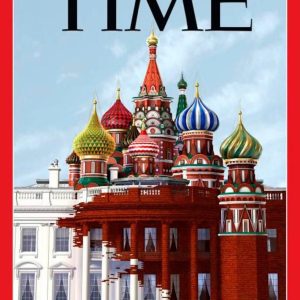
▶︎ Meanwhile, the Trump administration amplifies paid Russian assets and agents of disinformation and division. The U.S. State Department is instructing its staff to deny visas to those engaged in activities like combatting misinformation, disinformation or false narratives, fact-checking, content moderation, compliance, and trust and safety. The Russian control of the U.S. government requires another post. America went from inspiring democracy to enabling autocracy around the world.
▶︎ But the Russians are way ahead of us. A new investigation exposed a global Russian intelligence influence network. Court documents show that Nomma Zarubina, charged in the U.S. for working with Russian intelligence, operated inside an international ecosystem blending “civil society,” youth diplomacy, and covert recruitment. Numerous Western intelligence agencies were collecting materials linked to this case.
This is not about one agent – it’s about a system. The case reveals how, over 30+ years, Russian security services have use conferences, diaspora groups, and youth platforms to identify, cultivate, and influence future decision-makers worldwide. This is why Russian operatives (and probably Chinese and Korean operatives) attend every technology conference and CxO event in the U.S.
▶︎ For the past decade, the dominant political narrative across much of the developed world has been the rise of the populist right. Brexit, Donald Trump’s first victory and the emergence of the Alternative for Germany (AfD) as a substantial force in German politics all emerged in 2016. Similar parties and politicians have attained or approached power in Italy, the Netherlands and France, while anti-immigrant attitudes in many countries have hardened and border restrictions tightened.
But that one-dimensional story has since become more complicated. Last year saw swings against incumbent parties with gains on both extreme flanks. And this year has seen big strides for what we might call the populist left, from Zohran Mamdani’s victory in the New York mayoral contest to Die Linke’s surge in the German election and the Greens’ brief rise to second place in one recent poll in the UK, amid calls for wealth taxes and rent control.
The deviation from a uniform story of populist rightwing insurgence may reassure some readers. However, upon closer inspection these apparently disparate shifts are all part of a coherent and perhaps even more troubling trend: the emergence and solidification of a politics that is anti-system, anti-growth and fundamentally premised on the idea that we live in a zero-sum world.
Extending work by Harvard economist Stefanie Stantcheva and others (which I referenced earlier this year), we find in the U.S., the UK, France and Germany zero-sum beliefs on the left (eg people only get rich by making others poor) and the right (eg immigrants succeed at the expense of the native-born) are related expressions of the same underlying worldview. Namely that there is only so much to go around and we must therefore use restrictions, exactions and preferential treatment to redress the balance between winners and losers. Such attitudes are divisive, adversarial and tend to have negative consequences for both economy and society. But far from being irrational or concocted by devious political entrepreneurs, the emergence of these beliefs in different countries and political systems points to their being grounded in a shared reality.
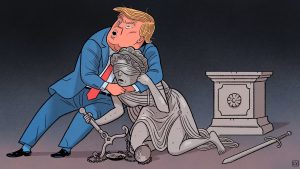
So, to all my readers and supporters, many, many thanks for your support and readership this year. I shall remain imaginative, resourceful, and driven to do my work. See you in 2026 . . . God willing, and the crik don’t rise.
Gaza is the new model: a preview of a global order where international law is discarded, colonial violence is normalized, and entire populations are sacrificed with impunity.
I am told the dispute over how to signify Israel’s violence – legitimate self-defense, just war in tough urban conditions, or ethnic cleansing and crimes against humanity – will never be settled.
No. The debate on whether Israel’s actions in Gaza constitute a genocide is now closed, and has been closed for a while. The international Court of Justice, all the major historians of genocide, the United Nations, all the major human rights organisations, and even a former Israeli Prime Minister all call the Gaza “war” a genocide. Public opinion across Europe and even the United States increasingly agrees. Israel supporters such as Representative Hank Johnson in the United States Congress now prefer to argue that a genocide has indeed taken place, while blaming Hamas for provoking it.
To borrow from Bruno Maçães, the main way the genocide has been actively supported by our democracies is less the flow of weapons and intelligence to Israel, important as these are, than the organized repression and punishment of everyone who dared to call attention to events in Gaza or offer criticism of Israel and its conduct. For the duration of the Gaza “war,” there has hardly been a week when I did not hear from a journalist or writer or politician confessing his or her fears of speaking their mind about Gaza. For two years, attention has been singularly focused on Gaza, not to prevent what happened but to bring it about.
It is not difficult to recognise, however, in the constellation of Israel’s moral and legal infractions signs of the ultimate atrocity: the frank and routine resolves from Israeli leaders to eradicate Gaza; their implicit sanction by a public opinion deploring inadequate retribution by the IDF in Gaza; their identification of victims with irreconcilable evil; the fact that most victims were entirely innocent, many of them women and children; the scale of the devastation, proportionally greater than achieved by the Allied bombing of Germany in the Second World War; the pace of the killings, filling up mass graves across Gaza, and their modes, sinisterly impersonal (Israel’s reliance on Al algorithms to track down suspects), and personal (snipers shooting children in the head, often twice); the denial of access to food and medicine; the hot metal sticks inserted into the rectum of naked prisoners; the destruction of schools, universities, museums, churches, mosques and even cemeteries; the puerility of evil soldiers dancing across Palestinian dead; the specific targeting and killing of 277 journalists in Gaza trying to tell the story.
The industrial scale of the Shoah has been ably met.
As Maçães says, the images of destruction in Gaza were a mirror. What they reflected back were glimpses of destruction in Europe and the United States: images not of physical rubble but of destroyed democracies. How were the horrors of Gaza possible? Quite simply, because those who tried to stop or expose them quickly discovered that our political systems were committed to the genocide and there simply was no way to give voice or power to a different politics. Often, one person would be ritually punished for their dissent in order to intimidate everyone else. On American universities during the genocide, almost everyone was too afraid to mount a decisive opposition. Those who were not afraid were quickly punished or silenced. Today, in Western societies, democracy stops when an issue becomes too central to the political regime. Unconditional support for Israel just happens to be one of those issues.
If there is a collapse in Western societies, it is not merely a collapse of media or political structures. It is much worse. It may well be a collapse of the human personality. Human beings do not emerge fully formed from the earth. Always and everywhere, they are social creations, but what our societies are creating no longer seem like human beings.