Everything in the universe vibrates like a guitar string, with a plethora of patterns, according to a new book

30 August 2025 (Greece) — Now safely ensconced back home as the world around me burns, I spent the weekend reviewing, editing and updating some previous pieces – some unfinished, some posted as *working drafts*, some just incoherent musings.
The following is a piece many of my regular readers saw last year, albeit it was a much shorter version. But as you get older, you see things differently, and you want to expand on what you wrote. For me, it’s the peculiar character of our current environmental impasse.
And by “peculiar character” I mean our impasse is at once unprecedented, obscure, and banal as the weather. We face not a day of reckoning, but “Apocalypse 24/7”.
This is not a doomsday you can prep for, hack your way out of, or hide from – but your world dissolving around you. Not something with a beginning and end, but the prelude of a new form of life to come, which those of us alive today will never live to see: a promised land not of milk and honey but fire and flood, veiled in ashes and dust, more felt than seen.
From an ecological perspective, we have created a new habitat less hospitable to the large bipedal primate we call Homo sapiens. On the ontological level, we have crossed a threshold into a new environing gestalt yet to coalesce, a new world not yet visible from where we stand. From an existential point of view, we face an impasse we cannot see through or beyond.
It’s not too much to say that the end of the world is at this point a given and that the question we face is what sort of world comes next, but as with the world we’re born into, what world comes after we’re gone is not something we get to choose. Our struggle is at once more direct and more obscure: how to live out our end.
It is why I maintain that those of us who live in modern, literate, global civilization must be capable of “rewilding” ourselves, “uncivilizing”, “going native” – getting the hell out of the Anthropocene. No, we cannot change at will our embedded and embodied relations with our other-than-human kin and the land itself – ripping up our civilization by the roots and degrowth it into a pastoral Eden.
But you need to get back to real nature. Or perhaps stated more accurately by the ecologist Paul Shepard:
“We can go always go back to nature because we never left it”.
For me it is Greece, in particular the islands. As I have noted in previous posts, it’s a place that is a bit mysterious at times and even a bit impenetrable at times, but awesome – made of earth, air, fire and water. It breathes. Here you can get a bit nearer to the stars and the ether.
And here, in Greece, I am surrounded by people who actually enjoy face-to-face encounters, away from a national conscious with its fevers of conspiracy and ancient hatreds and malignity. My world here is not (yet) poisoned and mutilated; we still delight in the seasonal rhythms … and the regenerations.
It’s why I immerse myself in the work of nature writers and ecologists like Rachel Carson and Jacques Cousteau, and the writers that Rachel Carson inspired like Annie Dillard, Kathleen Jamie, Rebecca Solnit, Scott Sanders, and Terry Williams.
And also going back to read the writers that inspired Rachel Carson, like Aldo Leopold, John Muir, and Henry David Thoreau.
Because when you do, you discover nature’s rhythms and vibrations, and nature’s patterns – such as fractals, spirals, and symmetries, all expressions of vibrational frequencies and resonance, a scientific phenomenon where specific sound or electromagnetic frequencies create distinct, repeatable shapes and structures in matter. This connection is observed in cymatics, which shows sound vibrations forming patterns in sand or water, and in the structure of natural objects like snowflakes and seashells. The pervasive influence of these vibrations and geometric laws dictates form and function, shaping everything from planetary rhythms to cellular division.
So this updated post will provide an introduction for my many new subscribers – my “Science Porthole” series which publishes every Sunday, although “Porthole” will go on a temporary hiatus while I disappear for awhile.
Let’s start with a short clip I shot arriving back in Ithaki harbor last summer, the cloud formations at sea and around us which just continue to amaze me. Lying flat on the deck of our boat, simply pointing my iPhone to the sky, and making an arc-like motion as we re-entered the harbor, I tried to capture just a glimpse of what we had seen:
But many times, standing on a beach, staring out at the ocean, watching waves roll in, I will become moved with the inarticulate sense of nature, the sublimity of it all. And even if I have my smartphone or camera with me, I avoid taking pictures – just enjoying the mental photogenic moment. Because the sublime is sublime because it exceeds representation, defies it, confronts our puny understandings with phenomena we can’t fully assimilate.
I have written about Matt Strassler in other posts. Matt is a theoretical physicist at Harvard University, and this trip I brought along his new book “Waves in an Impossible Sea: How Everyday Life Emerges from the Cosmic Ocean” for a re-read. I had written a review last year but this trip came away with some new thoughts.
Reality often seems stranger and more dazzling than the most inspired fiction. Space, for instance, can warp, stretch, and ripple, like rubber, as Einstein taught us. And yet we travel through it, as passengers on Earth, at 150 miles per second – without feeling the slightest resistance. How can that be?
This is among the questions with which Matt opens in his book. His answer: Our tangible world – chairs and trees and dogs and human beings – exists not “within” the universe but is made “of” the universe itself, built from the same waves that constitute space.
Note to readers: I have a university degree in physics … my second, “minor” degree (requiring less course work than my major degree in economics) … taken way back in what now feels like the Mesozoic Era, and I have kept current in physics as my outside hobby. It still accounts for 25% of my weekly readings. More in my postscript below.
I like Matt’s book because it seems mostly aimed at the reader who has read very little about physics. Strassler spends quite a bit of time explaining simple concepts, such as waves and inertia, which many readers of popular physics books will already understand, but may find tedious to revisit. But Matt makes it easy.
How do we understand those waves? With quantum field theory, which Strassler argues underlies all of reality. It tells us that everything in our universe is made up of fields, much like our familiar electric and magnetic fields. Particles like protons, electrons, and Higgs bosons are excitations of these fields. How these fields are built and give rise to particles is at the heart of Strassler’s book.
These are weighty concepts, and yet Strassler writes with enviable conversational simplicity, drawing parallels between the waves and vibrations we know in our everyday lives – especially those in music (of which he is a connoisseur) – and the waves and particles of modern physics. In places, he coins delightfully pithy phrases that feel intuitive, for instance the “Higgsiferous ether” for the Higgs field which is at the heart of what imparts mass to certain particles in the universe. The law of inertia is the “coasting law.” A scalar field – a field for a property, like temperature or pressure, which is defined only by a value at every point in space and not a direction – is “non-pointing.”
Strassler also pitches frequent questions about physics in the form of conversations he has had with his students and non-scientist friends. This provides a fun narrative frame and an easy way to resolve any doubts a novice reader might have about the tricky concepts he’s explaining.
For instance, Strassler recounts a conversation he had in a coffee shop about the seemingly paradoxical notion that because all motion is relative, we can be both stationary and in motion at the same time: you don’t feel the ground you stand on hurtling around the sun at 150 miles a second. Every fact of the physical universe has to be consistent with this deceptively simple-sounding principle of relativity, which runs like Ariadne’s thread through the narrative to keep us from getting lost.
Strassler uses the relativity principle and the coasting law (law of inertia) to demolish a common misconception – a physics fib, or “phib” as he calls it – about the Higgs boson, an elementary particle that gets lots of time in the spotlight. The particle arises from the “Higgsiferous ether” – aka the Higgs field – and the phib is that it’s a kind of treacly soup which, by virtue of its resistance to motion, “gives objects mass.” If this phib were true, it would mean that the Higgs slows objects down, whereas in fact it allows them to coast, according to the coasting law. If the phib were true, the Higgs field would also slow moving objects but have no impact on stationary objects, a state of affairs that would be inconsistent with the relativity principle.
It’s more accurate, Strassler suggests, to think of the Higgs field as a “stiffening agent” that interacts with the fields of many different particles and turns them from floppy to stiff, much like the gravitational field turns a floppy pendulum that’s swinging all over a place into a bob swinging with metronomic precision. The very things we call particles, in Strassler’s vocabulary, should be called “wavicles” – wavy manifestations of fields, like the different harmonic modes of vibration on a violin or guitar string when it is plucked.
What the Higgs field does is interact with other fields’ “resonant frequencies”.
Note to readers: a resonant frequency is the natural frequency at which a field vibrates when set vibrating and left undisturbed.
The Higgs field interacts strongly with wavicle fields with high resonant frequencies – like those of the top quark and electrons – which are then stiffened, so that their masses can be said to come from the Higgs mechanism. By contrast, the Higgs field interacts negligibly with wavicle fields with low resonant frequencies, like those of gluons which hold together the quarks that make up protons and neutrons. The latter fact is why everyday objects like human bodies, which get almost all their masses from protons and neutrons, have scarcely anything to do with the Higgs boson: 99 percent of their mass comes from the energy of interaction between the quarks and the gluons.
But paradoxically, he omits much of the history of modern physics, which forces him to compress other key ideas. He conceded in one endnote:
“I, too, risk contributing to myth-making here. I am drastically abridging the complex prehistory of Einstein’s ideas”.
Take symmetry. It’s intimately connected to the existence of conservation laws for energy and other fundamental properties. But the book does not dwell on why the breaking of this symmetry for the electromagnetic and weak forces gives rise to the Higgs mechanism. Historically this was a significant development leading to the discovery of the Higgs field, and touching on it would have illuminated an important principle.
Nevertheless, Strassler’s efforts to illuminate fundamental aspects of the universe’s makeup are commendable – and enjoyable to read. To understand the dance of fields at work in our ordinary, everyday lives is to realize that there’s nothing ordinary about them.
As Strassler writes, we are all “wavicle-creatures,” and “the universe sings everywhere, creates patterns everywhere, in everything.”
POSTSCRIPT
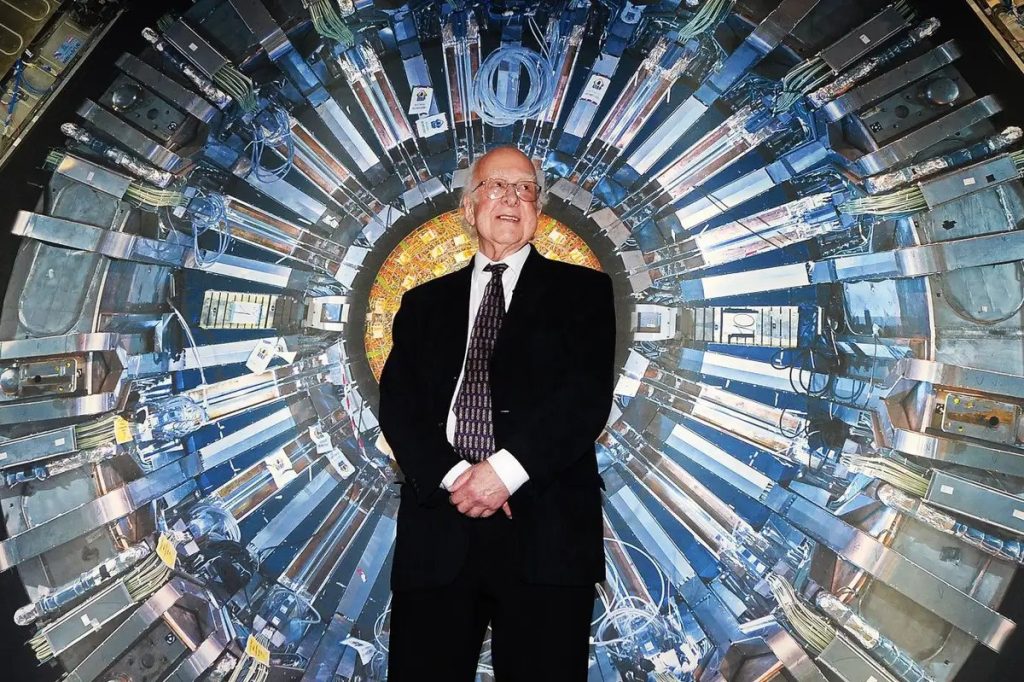
ABOVE: Peter W. Higgs at the Science Museum in London in 2013 at the opening of the special exhibit on the Higgs boson and the Large Hadron Collider at CERN near Geneva, Switzerland which proved his theoretical predictions.
In 2013, the Nobel Prize in Physics was awarded jointly to François Englert and Peter W. Higgs “for the theoretical discovery of a mechanism that contributes to our understanding of the origin of mass of subatomic particles, and which recently was confirmed through the discovery of the predicted fundamental particle, by the ATLAS and CMS experiments at CERN’s Large Hadron Collider”. Higgs passed away in April 2024.
Yes, I have a degree in physics degree. But as noted, it is my “minor” degree, not my “major” degree which was in Economics. Physics required a lighter course load for a “minor”.
But – irony of ironies – it was that physics degree that got me my first job, on Wall Street. Quantum mechanics, a branch of physics explaining subatomic particle behavior, serves as the foundation for modeling stock return dynamics and currency trading. Stock return drift results from an external potential representing market forces, pulling short-term fluctuations back to long-term equilibrium.
It is a long story on how I used it for 3+ years before attending law school. Fodder for another post.
But waaaaaaay back in 2010, my life changed. Nick Patience (one of the founders of 451 Research, the well-known analyst of business enterprise IT innovation and emerging technology segments) invited me to attend the annual 451 Hosting & Cloud Transformation Summit in London. I had known Nick for a number of years and he had invited me to several 451 events where the knowledge I gained has always informed my work and my blog posts.
But the Cloud Summit was different. Nick introduced me to Brian Cox, who was the keynote speaker. Brian, as most of you know, is Professor of Particle Physics and one of the leaders on the ATLAS experiment at the Large Hadron Collider (LHC) at CERN in Geneva. He is a physics star turned pin-up professor whose several series on the solar system and science have sent his career into orbit. Universities who have seen a surge in applications for physics programs call it the “‘Brian Cox effect”.
At that cloud conference – populated by folks who certainly work with large amounts of data – Brian dazzled the crowd with real data loads. Like the 40 terabytes that were created – per second. That’s was how much data was thrown off at the time by the LHC, the world’s largest and highest-energy particle accelerator.
That introduction led to an email exchange with Brian, and an invitation to CERN which is located near Geneva. It ramped up my interest in physics and led to a whole string of further introductions at the Swiss Federal Institute of Technology (ETH), the Swiss AI Lab, the Delft University of Technology, the Grenoble Institute of Technology, etc., etc. And it also led to the start of my AI/informatics program.
All of this came flooding back to me when I learned of the death of Peter Higgs (age 94) last April, occurring on the same day of the total solar eclipse. Peter was an unassuming star in the science community. He valued the respect of his colleagues and treasured his occasional “bright ideas” about the way the universe worked.
The fact that one of those bright ideas ended up boiled down into an object bearing his name, which became the subject of a world-encompassing multi-billion-dollar “quest”, was a source of some exasperation. The Higgs boson’s discovery, he said, “ruined my life”.
The discovery of the Higgs boson came nearly 50 years after Higgs’s prediction, and he said he never expected it to be found in his lifetime.
Dr Higgs’s best-known bright idea was arcane but crucial and I shall not go into it now. Matt covers it very well in his book (which I have summarized above). But Peter’s work and Matt’s book allowed me to come away with several working concepts.
1. Science in general, and physics in particular, seek patterns. Stretch a spring twice as far, and feel twice the resistance. A pattern. Increase the volume an object occupies while keeping its mass fixed, and the higher it floats in water. A pattern. By carefully observing patterns, researchers uncover physical laws that can be expressed in the language of mathematical equations.
2. A clear pattern is also evident in the case of a compass: Move it and the needle points north again. I can imagine a young Einstein thinking there must be a general law stipulating that suspended metallic needles are pushed north. But no such law exists. When there is a magnetic field in a region, certain metallic objects experience a force that aligns them along the field’s direction, whatever that direction happens to be. And Earth’s magnetic field happens to point north.
3. The example is simple but the lesson profound. Nature’s patterns sometimes reflect two intertwined features: fundamental physical laws and environmental influences. It’s nature’s version of nature versus nurture. In the case of a compass, disentangling the two is not difficult. By manipulating it with a magnet, you readily conclude the magnet’s orientation determines the needle’s direction. But there can be other situations where environmental influences are so pervasive, and so beyond our ability to manipulate, it would be far more challenging to recognize their influence.
4. Physicists tell a parable about fish investigating the laws of physics but so habituated to their watery world they fail to consider its influence. The fish struggle mightily to explain the gentle swaying of plants as well as their own locomotion. The laws they ultimately find are complex and unwieldy. Then, one brilliant fish has a breakthrough. Maybe the complexity reflects simple fundamental laws acting themselves out in a complex environment—one that’s filled with a viscous, incompressible and pervasive fluid: the ocean. At first, the insightful fish is ignored, even ridiculed. But slowly, the others, too, realize that their environment, its familiarity notwithstanding, has a significant impact on everything they observe.
5. Does the parable cut closer to home than we might have thought? Might there be other, subtle yet pervasive features of the environment that, so far, we’ve failed to properly fold into our understanding? The discovery of the Higgs particle by the Large Hadron Collider in Geneva convinced physicists that the answer is a resounding yes.
But it’s only with data that a link to reality can be forged. For the Higgs field, we had the Large Hadron Collider (LHC) – winding its way hundreds of yards under Geneva, Switzerland, crossing the French border and back again, the LHC is a nearly 17-mile-long circular tunnel that serves as a racetrack for smashing together particles of matter.
Establishing the existence of a new form of matter is a rare achievement, but the result has resonance in another field: cosmology, the scientific study of how the entire universe began and developed into the form we now witness. For many years, cosmologists studying the Big Bang theory were stymied. They had pieced together a robust description of how the universe evolved from a split second after the beginning, but they were unable to give any insight into what drove space to start expanding in the first place. What force could have exerted such a powerful outward push? For all its success, the Big Bang theory left out the bang.
Oh, you can read thousands of journal articles on this, and read about the billions of dollars that have been spent on deep space observations seeking—and finding—indirect evidence that these theories accurately describe our universe. To me, just fascinating stuff.
But for me the discovery of the Higgs particle is an astonishing triumph of mathematics’ power to reveal the workings of the universe. It’s a story that’s been recapitulated in physics numerous times, but each new example thrills just the same.
Before a short postscript, I’ll leave you with a comment by Nobel laureate Steven Weinberg (Physics, 1979), plus a comment by Werner Heisenberg. In his Nobel Prize speech Weinberg said:
“Our mistake in science is often not that we take our theories too seriously, but we do not take them seriously enough. It is always hard to realize that these numbers and equations we play with at our desks have something to do with the real world. We pound ourselves in our labs, sometimes doubting our own proofs. Sometimes those numbers and equations have an uncanny, almost eerie ability to illuminate otherwise dark corners of reality. When they do, we get that much closer to grasping our place in the cosmos”.
It is worth remembering, as Peter Higgs always knew, that what really matters in science is the process, not the prize.
And Werner Heisenberg who said:
“We have to remember that what we observe is not nature herself, but nature exposed to our method of questioning”.

The various lifeworlds of various indigenous peoples through the centuries emerged through their meaningful relations to specific ecosystem features, particular species of flora and fauna, and reliable regional climatological patterns.
All these aspects of reality are now in flux in our *modern* world, sometimes catastrophically. We cannot simply return to an animist world rich in meaning when that world has been stripped of the diversity and richness of nonhuman life in relation to which said meaning emerged, while our own daily practices remain embedded in an anthropogenic world of industrial technology, specialized labor, and complex social hierarchy.
Which is to say that modern humans are alienated from nonhuman nature today not by bad ideology or the wrong narratives but by the material structures of industrial life.
We don’t hunt our own food.
We don’t grow our own corn.
We don’t make our own clothing, tools, or homes.
We don’t produce our own heat.
We are protected from most climatic variation.
Our doctors treat illnesses with sophisticated pharmaceuticals and technological apparatuses.
Our survival does not depend on close attention to the land, the plants around us, our animal kin, or the weather, but on attention to traffic, the market, and social media.
And the meaning of our world is mediated not by the language of animals, plants, earth spirits, and sky gods but by text and images on pages, screens, doors, walls, billboards, and gas pumps.
And so the problem is the scale of disordering violence to which we subject ourselves, outstripping anything advocates of indigenous epistemologies or *uncivilization* would have accepted.
We are experiencing something indistinguishable from global genocide.
Indigenous ways of knowing and living have never in the history of the planet supported more than 50 million human beings at once; to envision humanity “becoming indigenous” in any real way would mean returning to primary oral societies with low global population density, lacking complex industrial technology, and relying primarily on human, animal, and plant life for energy. It would mean bringing down the entire system within which we now live – tearing down skyscrapers, blowing up gas stations, burning books, smashing screens, and dismantling complex machines, including harvesters and freezers and centrifuges – and letting more than 99% of Earth’s current population die.
Correct. Not going to happen. Or as Frantz Fanon wrote (and mind you this was in the 1950s):
“You cannot disorganize society. Every cannot become indigenous. Indigeneity is always local, and so we cannot become illiterate. And not just our energy use, not just our ecology. Our modes of governance, ongoing racial injustice, and our understandings of ourselves as human are the roots of our plantation logic, forced literacy, centralized agriculture, and creation of private property”.
And so, yes, we are doomed. Every “obstacle” to environmental solution means the reduction or elimination of the material infrastructure of our lives: streets, houses, computers, cars, planes, medicine, cheap energy, cheap food, modern dentistry, refrigeration, central heating, electricity, synthetic-cotton blends, toothpaste, printing presses, PDFs, email.
Thus while pre-modern indigenous social formations are doubtlessly more ecologically sound than the ones offered by progressivist capitalism, the only path to reach them lies through the end of the world.
Well, the human world. Dipesh Chakrabarty likes to say there are least four different ways of talking about our relationship with the spinning rock on which our species’ life depends. Our world is also a planet, a globe, and the Earth. We might say, somewhat reductively and with due respect to Chakrabarty’s finely textured analysis, that the globe is political, the planet scientific, the Earth phenomenological, and the world ontological.
Thus when we talk about our degrading environment bringing an “end to the world” we are speaking almost exclusively in an ontological register. The human political collectives shall be gone, not the planet. Ok, our sun is dying and the Earth will become a cinder, a white dwarf. But that’s 5 billion years down the road. Relax.
So for now, for me anyway, it’s just a desire, a need to understand nature – to engage my five senses by going outside and observing my surroundings, learning about local plants and animals, and noticing the interconnectedness of all living things.
And continuing to cultivate a sense of wonder, curiosity, and empathy for nature just to deepen my connection and understanding of the natural world.