A note to my new readers, and updated for my long-time readers

1 March 2025 – My media team and I receive and/or monitor about 3,500 primary resource points every week – about 500 a day. But we use an AI program built by my CTO (using the Factiva research database + four other media databases) plus APIs like Cronycle that curate the media firehose so we each only receive selected, summarized material that pertains to our current research needs, or reading interest.
Almost every day – in the morning, afternoon or evening – I will choose a story to share with you: some out-of-the-ordinary story, or perhaps a “normal” main stream story, and share my reflections on a current topic.
I take the old Spanish proverb to heart:
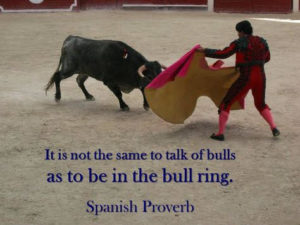
Or even better:
“A desk is a dangerous place from which to watch the world”.
-John le Carré, in The Honourable Schoolboy
le Carré was correct. I am seeped in technology. Much of the technology I read about or see at conferences I also force myself “to do”. Because writing about technology is not “technical writing.” It is about framing a concept, about creating a narrative. Technology affects people both positively and negatively. You need to provide perspective. You need to actually “do” the technology.
But it applies to all things. In many cases I venture onto ground where I’ve no guarantee of safety or of academic legitimacy, so it’s not my intention to pass myself off as a scholar, nor as someone of dazzling erudition. It has been enough for me to act as a complier and sifter of a huge base of knowledge, and then offer my own interpretations and reflections on that knowledge.
No doubt the old dream that once motivated Condorcet, Diderot, or D’Alembert has become unrealizable – the dream of holding the basic intelligibility of the world in one’s hand, of putting together the fragments of the shattered mirror in which we never tire of seeking the image of our humanity.
But even so, I don’t think it’s completely hopeless to attempt to create a dialogue, however imperfect or incomplete, between the various branches of knowledge effecting and affecting our current state.
And it’s difficult. As I have noted before, we have entered an age of atomised and labyrinthine knowledge. Many of us are forced to lay claim only to competence in partial, local, limited domains. We get stuck in set affiliations, set identities, modest reason, fractal logic, and cogs in complex networks. And too many use this new complexity of knowledge as an excuse for dominant stupidity. We must fight that.
It’s the only way I understand writing. It’s certainly the way I’ve been all my life and it’s how every other writer I admire is – a kind of monomaniac. I’m not sure how you can make any art if you don’t treat it very seriously, if you’re not obsessed with doing it better each time.